
Towards a theology of death
摘要
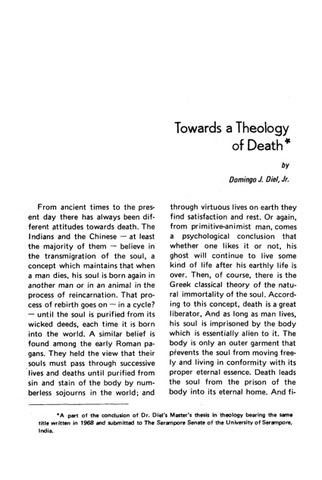
From ancient times to the present day there has always been different attitudes towards death. The Indians and the Chinese — at least the majority of them — believe in the transmigration of the soul, a concept which maintains that when a man dies, his soul is born again in another man or in an animal in the process of reincarnation. That process of rebirth goes on — in a cycle? — until the soul is purified from its wicked deeds, each time it is born into the world. A similar belief is found among the early Roman pagans. They held the view that their souls must pass through successive lives and deaths until purified from sin and stain of the body by numberless sojourns in the world; and through virtuous lives on earth they find satisfaction and rest. Or again, from primitive-animist man, comes a psychological conclusion that whether one likes it or not, his ghost will continue to live some kind of life after his earthly life is over. Then, of course, there is the Greek classical theory of the natural immortality of the soul. According to this concept, death is a great liberator, and as long as man lives, his soul is imprisoned by the body which is essentially alien to it. The body is only an outer garment that prevents the soul from moving freely and living in conformity with its proper eternal essence. Death leads the soul from the prison of the body into its eternal home. And finally, there is the Hebrew-Christian tradition about death. According to this concept, death involves the whole man — the living soul — and not just the body. The whole man who has really died is recalled to life by a new act of creation in the Resurrection. Death is conquered and man becomes immortal through the resurrection of Jesus Christ and through faith in Him.
描述
Journal article
建议引文
Diel, D. J., Jr. (1976). Towards a theology of death.文件类型
Article國際標準期刊編號
0038-3600主题

集合
- Southeast Asia Journal [188]
相關項目
顯示由標題,作者,創造者和主題相關的項目。
-
Towards a theology of death: Death in life and life in death
(Institute of Advanced Theological Studies (IATS) and College of Theology, 2006)A lecture about the Christian perspective on death. -
Coping with death, separation and loss
(Institute of Advanced Theological Studies (IATS) and College of Theology, 2006)Grief is a normal process to a loss of a person (loved one), thing (precious possession) or relationships (friends, pets) for which we have cared deeply. Our goal is not to avoid grief but to deal with it wisely and ... -
Statement of mourning and remembrance
(Panay News, 2023-08-01)It is with deep and great sadness that the Board of Trustees and the entire Central Philippine University community mourn the passing of DR. JUANITO M. ACANTO who faithfully served as the University President for 12 years ...