
The Bisayas of Borneo and the Philippines: A new look at the Maragtas
요약
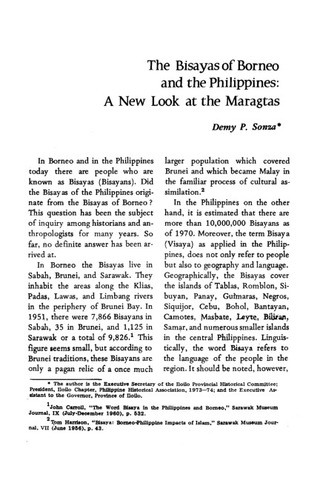
In Borneo and in the Philippines today there are people who are known as Bisayas (Bisayans). Did the Bisayas of the Philippines originate from the Bisayas of Borneo? This question has been the subject of inquiry among historians and anthropologists for many years. So far, no definite answer has been arrived at.
In Borneo the Bisayas live in Sabah, Brunei, and Sarawak. They inhabit the areas along the Klias, Padas, Lawas, and Limbang rivers in the periphery of Brunei Bay. In 1951, there were 7,866 Bisayans in Sabah, 35 in Brunei, and 1,125 in Sarawak or a total of 9,826. This figure seems small, but according to Brunei traditions, these Bisayans are only a pagan relic of a once much larger population which covered Brunei and which became Malay in the familiar process of cultural assimilation.
In the Philippines on the other hand, it is estimated that there are more than 10,000,000 Bisayans as of 1970. Moreover, the term Bisaya (Visaya) as applied in the Philippines, does not only refer to people but also to geography and language. Geographically, the Bisayas cover the islands of Tablas, Romblon, Sibuyan, Panay, Guimaras, Negros, Siquijor, Cebu, Bohol, Bantayan, Camotes, Masbate, Leyte, Biliran, Samar, and numerous smaller islands in the central Philippines. Linguistically, the word Bisaya refers to the language of the people in the region. It should be noted, however, that Bisaya comprises several closely related dialects, principally Aklanon, Kiniray-a, Hiligaynon (Ilongo), Sugbuhanon (Cebuano), and Waray-Waray.
What is the origin of the word Bisaya? Many theories have been advanced in this regard.
기술
Journal article
The author is the Executive Secretary of the Iloilo Provincial Historical Committee; President, Iloilo Chapter, Philippine Historical Association, 1973—74; and the Executive Assistant to the Governor, Province of Iloilo.
추천 인용
Sonza, D. P. (1974). The Bisayas of Borneo and the Philippines: A new look at the Maragtas.유형
ArticleISSN
0038-3600주제

Collections
- Southeast Asia Journal [188]
Related items
Showing items related by title, author, creator and subject.
-
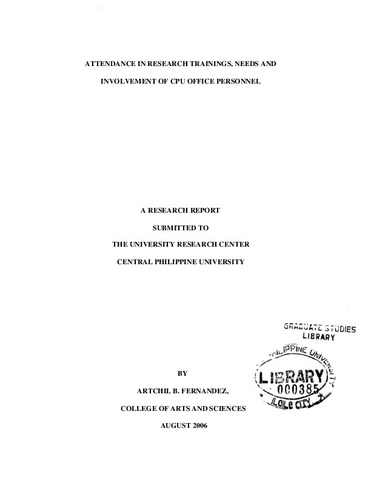
Attendance in research trainings, needs and involvement of CPU office personnel
(Central Philippine University, 2006-08)The study was conducted mainly to determine the attendance in research trainings, needs and research involvement of CPU office personnel. It utilized a one-shot survey design. Using census technique (total enumeration), ... -
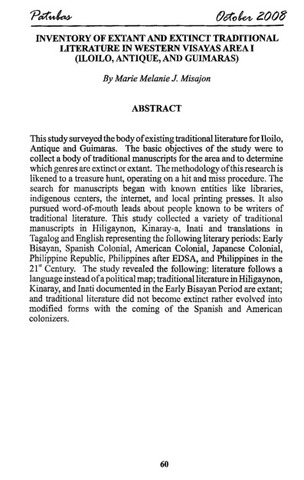
Inventory of extant and extinct traditional literature in Western Visayas area I (Iloilo, Antique, and Guimaras)
(Central Philippine University, 2008-10)This study surveyed the body of existing traditional literature for Iloilo, Antique and Guimaras. The basic objectives of the study were to collect a body of traditional manuscripts for the area and to determine which ... -
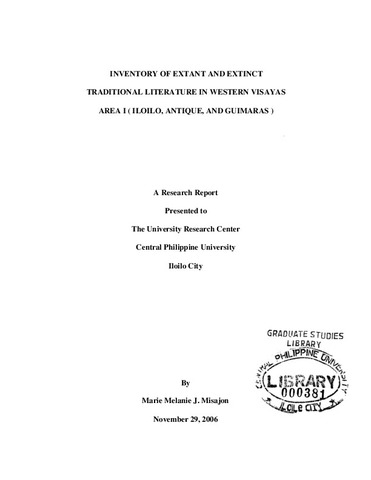
Inventory of extant and extinct traditional literature in Western Visayas area I (Iloilo, Antique, and Guimaras)
(Central Philippine University, 2006-11)This study surveyed the body of existing traditional literature for Iloilo, Antique and Guimaras. The basic objectives of the study are to collect a body of traditional manuscripts for the area and to determine which genres ...