

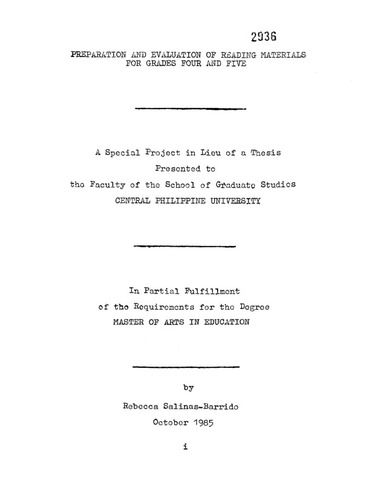
Preparation and evaluation of reading materials for grades four and five
Abstract
Reading is a part of language acquisition which one needs in his daily life. This avenue of communication is essential to his complex social arrangement. According to Deboer and Dallman, reading becomes synonymous with education itself. It includes all perceptive observation of the real world around us. Fitzgerald and Fitzgerald, further pointed out that reading is a guide to achievement and progress on the job and the avenue of enrichment off the job.
Heading is a complex process. It is not a general ability but a composite of many abilities. It is not a simple mechanical skill, the sounding out of printed words either with or without comprehension of meaning. It is neither the ability to read aloud, assuming that good oral readers automatically make good readers. The process depends on what the readers bring to the printed page, thus giving meaning to what is read. It is an activity which involves comprehension and interpretation of ideas symbolized by written or printed language.
The reading teacher has the task to help pupils acquire basic skills in reading, word recognition, and comprehension; and develop their interest in, and genuine love for, reading.
Interest is a great motivating factor in teaching the child to read. Interests, according to Tumaob, are powerful in directing the children’s reading behavior.
When pupils are interested in the reading selection, they enjoy reading. This pleasure motivates them to read more.
A child who lacks interest in reading fails to bring meaning to printed symbols and fails to comprehend what the writers say. These failures are indications that he is not reading, so he runs the risk of becoming an adult handicapped in many phases of learning.
Children learn to read more easily if material is meaningful and if they are interested in the ideas and/or the ways ideas are expressed. Furthermore, children are most likely to read with comprehension materials that deal with topics of interest to them. Sutaria states that, interest is an intangible aspect of a reading, text. Ideas that can be related to a student's own experience will more likely interest him, and when material is interesting to the reader, he develops a concern which helps carry him over difficulties of interpretation.
A wealth of reading materials is needed to avoid disappointment among pupils and prevent them from becoming retarded readers when they reach higher grades. Canciolo, says that the quality of reading materials pupils were first exposed to will influence their reading tastes, values, and appreciation of literature. Pupils who have been encouraged to read worthwhile materials acquire good reading habits and interest and further motivation to do independent reading and learning throughout their lives.
Statement of the Problem
One of the causes of poor reading instruction in the elementary schools is insufficiency of reading materials. Alano, states that the need for adequate reading materials has always been a problem in public schools. It is a particular problem in areas in the Philippines where children and teachers are bilingual and where much of the schoolwork is done in the children's second language.
The findings of Soutele reveal the same reason for pupils' difficulties with reading and writing. A major cause is the shortage of instructional materials. This problem was first earlier expressed by a former Minister of Education and Culture, Juan L. Manuel, when he said that 45 per cent of grade six pupils in the public elementary schools could hardly read with understanding.
Reading materials in public schools are limited. Books, workbooks, and other ready-made materials are expensive and few. Some of these materials do not fit the reading level of school children now using them. Because of limited and inappropriate reading materials, children are divested of the anticipation, delight, and enjoyment of discovering new things in print. On their part, teachers allow materials to dictate what would he taught. Admittedly, a few teachers do what a text tells them to do because following a book page by page is an easy way to conduct a class. Clearly, this is a confusion in roles. This problem could be remedied if reading teachers are aware of their role in improving our educational program. Teachers will be benefited if their classrooms have enough reading materials to develop skills in vocabulary building, pronunciation, structural analysis, and comprehension. These materials are needed to meet individual needs of pupils in public schools as well. The acquisition and utilization of these materials can help children acquire reading skills which are useful in their adjustment to their changing world.
Beset by this problem but imbued with the desire to help strengthen the Reading Program of the Division of Iloilo, the researcher attempted to prepare and evaluate reading materials based on the interests and reading levels of the pupils.
In addition, the researcher sought to establish the readability, validity, reliability, and usability of the reading materials for the intended grades.
Description
Introduction and statement of the problem
Suggested Citation
Barrido, R. S. (1985). Preparation and evaluation of reading materials for grades four and five (Unpublished Master’s special paper). Central Philippine University, Jaro, Iloilo City.
Type
Special paperSubject(s)

Department
School of Graduate StudiesDegree
Master of Arts in Education with specialization in Reading (English)Shelf Location
GSL Theses 378.242 B276 1985
Physical Description
237 leaves