

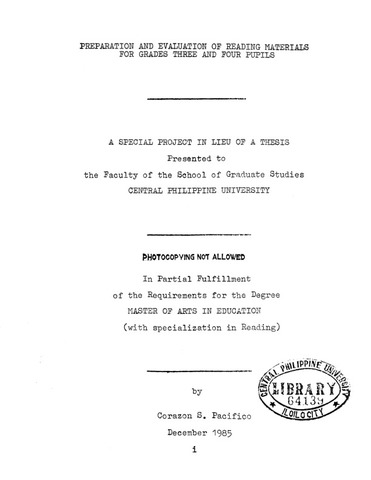
Preparation and evaluation of reading materials for grades three and four pupils
요약
Introduction
Reading is a vital human activity and its importance cannot be over-emphasized. An individual can scarcely survive in present-day society without adequate reading skill. His waking day begins with reading one thing or another—labels of canned goods, headlines of newspapers, instructions, or signs and signboards. More and more, he has to make use of the reading skills he has developed for years. He relies on his store of meaning of the words he encounters in his job or among his peers. Reading has become an indispensable skill in attaining success in his job and fruitful interaction with other people. To be able to participate fully in society, he needs to have achieved a high level of literacy. For, according to Triggs, "reading could be one of the most productive tools of modern living."
Reading skills are not learned sporadically, but rather as a hierarchy from the simplest to the most complicated, from the least to the most difficult. Neither are they learned in isolation, for one skill may be dependent on another skill and oftentimes involve the use of previously learned skills or even those skills not yet learned. Basic skills are learned in the primary grades, and equipping the learner with adequate basic skills would help him greatly as he learns more complicated and difficult skills.
Since most of the reading skills are learned in the primary grades, the primary years of the child are the most crucial in the development of reading skills. It is imperative, however, that instruction on these skills be strengthened. It is expedient, therefore, that reading instruction be enriched, reinforced, and emphasized. The attainment of these objectives demands the need for a comprehensive and functional reading program. What should such a reading program contain? Jenkinson believes that "the mainstays of any programme of reading must be the continuing development of word recognition, the extension of knowledge of vocabulary, and accurate comprehension,"
The reading program in schools is beset with the problem of scarcity of reading materials. McCullough3 observes that "most countries are in need of reading materials which contain tests and exercises for evaluation, and which would allow children to learn by themselves."
In most classrooms, teachers depend on prescribed texts regardless of their suitability to the ability and need of the pupils. Furthermore, these materials do not contain adequate exercises which would develop the reading skills of the pupils. There is a need, therefore, for preparing readable, high-interest supplementary or support materials containing exercises and tests as a form of evaluation, which tests have passed testing for validity, reliability, and usability.
Statement of the Problem
The specific purpose of this project was to prepare interesting reading materials which could help children in grades three and four to develop vocabulary, word attack, and comprehension skills, which are specified in the Revised Elementary Learning Continuum and the Barbe Reading Skills Check List Sequential Skill Plan.
The main purpose of this study was to prepare and validate reading materials for grades III and IV pupils. Its objective was to establish the validity, reliability, and usability of the prepared reading materials. A teacher's manual was prepared to give the teacher a valuable background and direction in using the materials.
The project also aimed to establish the validity, reliability, and usability of the prepared reading materials and to prepare a teacher’s manual for these materials.
기술
Introduction and statement of the problem
추천 인용
Pacifico, C. S. (1985). Preparation and evaluation of reading materials for grades three and four pupils (Unpublished Master’s special paper). Central Philippine University, Jaro, Iloilo City.
유형
Special paper주제

학과
School of Graduate Studies정도
Master of Arts in Education with specialization in Reading (English)선반 위치
GSL Theses 378.242 P119
물리적 설명
197 leaves