

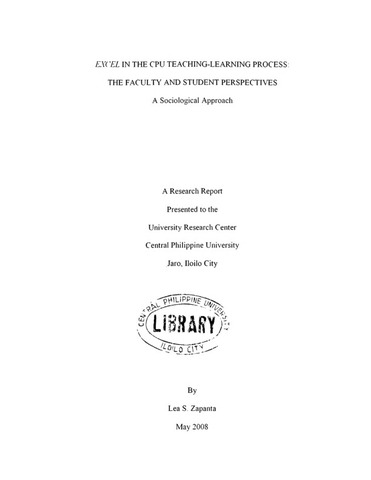
EXCEL in the CPU teaching-learning process: The faculty and student perspectives: A sociological approach
摘要
The study sought to discover the nature of the involvement of the faculty and students in the teaching-learning process, as influenced by the University’s Exemplary Christian Education for Life (EXCEL) vision goals. The study also examined how the university's core values guided the faculty and students in their teaching and learning activities. It also examined the use of the communication dyad in the instructional process. The study respondents consisted of a random sample of 42 full-time faculty and 997 undergraduate senior students of the population of the different colleges of the University. This number excludes students from the College of Medicine and the College of Law. The descriptive normative research design was used to gather and organize the data while the rank order correlation and cross-tabulation methods were used to analyze and describe the data. The first method was used to assess the priorities of faculty and students on the study’s instruction variables in the attainment of the EXCEL goals. The second method was used to discover relationships among these study variables. It can be inferred from the findings is that the faculty members are concerned with their teaching competence, as well as meeting their students’ learning needs, while the students’ foremost concern was on meeting their personal learning needs. Students looked up to their teachers as role models to help them in meeting their need for more knowledge. It may also be inferred that students are more self-oriented as compared to the faculty, who go beyond self as they reached out to their students. Both respondents ranked no. 1 indicator, their “engagement in daily acts which should never leave the norms of excellence, in terms of learning and teaching, in terms of value-oriented inter-personal behaviors, and in terms of more creative efforts that widen horizons of CPU quality instruction”. Also, both faculty and student respondents ranked no. 1, the component statement of Communication Aptitude, that “communicators must know how to start and end the communication, how to make themselves understood, how to respond to partner’s statements, how to be sensitive to partner's concerns, how to take turns, and how to listen. Both recognize that “teachers and students are the centers of instructional improvement; they alone can improve, motivate and self-regulate, with the assistance of department heads and deans”. The respondents differed on their number one University core value. The faculty ranked “commitment” while the students ranked “Christian Faith” as no. 1 in influencing them towards attaining the goals of EXCEL. But what must be specially noted are the findings covering the following: While both the faculty and students similarly ranked as no, 1 the motivating factor of “considering their moral and spiritual needs at all times and all circumstances the findings reflect that the faculty’s moral and spiritual values are not significantly related to their teaching, motivation and classroom management styles.
描述
Abstract only
建议引文
Zapanta, L. S. (2008). EXCEL in the CPU teaching-learning process: The faculty and student perspectives: A sociological approach (Research report). Jaro, Iloilo City: University Research Center, Central Philippine University.
文件类型
Technical Report主题

货架位置
GSL 378.242 Z174
物理描述
ix, 201 leaves
集合
- Research reports [42]
- Research reports [167]