

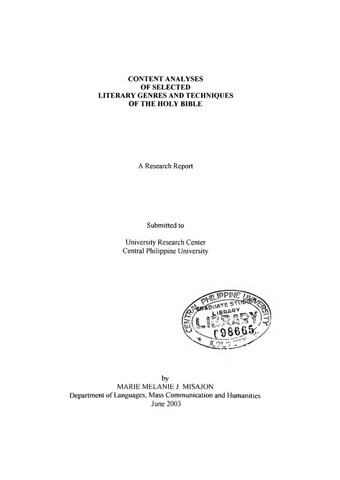
Content analyses of selected literary genres and techniques of the Holy Bible
Résumé
It is a foregone conclusion that the Holy Bible is a collection of documents, which constitute excellent literary writings. Through the ages, classical literature has spun off either in reaction to, or in defense of the information in the Bible. Innumerable contemporary Biblical scholars have not only dissected doctrines, but have magnified in varied details the aesthetic value of literature deeply embedded in the nature of the Bible. This study does not make any pretension about pioneering grounds in the area of literary Biblical studies, but rather, aims to provide supplementary information, which the world may welcome, considering the vastness of information contained in the Holy Bible. The conceptual framework combines the two distinct areas of studies: Biblical analysis and literary analysis. Analysis of Biblical verses is known as hermeneutics and analysis of literature is known as literary criticism. This study involves reading and analyzing scriptural verses from the perspective of literature. With this combination, the conceptual framework may be aptly called literary hermeneutics or explaining Scripture from the point of view of the art of words and meanings. There is no focus on doctrine or argumentation for it, rather, in the meaning of the cited verse and the aesthetic value arising from its literary quality. Using literature as a yardstick of analysis involves searching for literary genres and techniques among the verses. 16 Books of the 66 Books of the New International Version, US, 1984 are chosen as the research corpus. The 66 books are first classified according to similarities of content. They are the books of Creation, Laws, History, Literature, Prophets, Life of Jesus, Birth of the Church, Pauline Letters to the Churches, Pauline Letters to His disciples, General Letter, Teaching of the Other Disciples, and the Future. Books that singly represent a category are selected. Random selection by lot drawing is used to determine samples for those with multiple books per category. These books are read thoroughly and the literary technique of each verse is identified. The literary genres of the groups of verses are also identified. These verses are grouped and analyzed according to the features of the genres and techniques. Techniques and genres, which appear in few verses, are discarded. Nine genres are identified with the sample verses. They are the drama, story, poetry, essay, biography, parable, letter, proverb and psalms The Book of Job has the unmistakable form of drama while stories stretch from Genesis onward. Poetry recurs in the Old Testament Books but especially so in the Song of Songs, Ecclesiastes, Job, Lamentations and Psalms. Essays dominate the New Testament books of 1 Corinthians, 1 John and Titus. Drama and the story are analyzed according to their literary structure containing plot, character and setting. Plot is further studied according to its stages of introduction, conflict, crisis, climax and the denouement. Poetry is studied according to its kind, lyric or narrative and the emotions in them identified. The source of cadence of the poetry is also mentioned. The essay and the letter are analyzed as a process of logical development of ideas while the biography as a summary of generations. The parable is studied as a juxtaposition of two ideas. The proverb is studied according to its usage of Hebrew poetic technique and the psalms according to its purpose and poetic structure. While the proverbs and psalms are plentiful in the Scripture, these are not unique genres to the Holy Bible. Other deity-worshipping groups have their own psalms and proverbs are not necessarily, religion based around the world. 10 literary techniques are identified and their usage explained in specific verses. These are: simile, metaphor, comparison, contrast, paradox, cause and effect, symbolism, sensory imagery, hyperbole and personification. A problem is encountered in the literary analysis of the Holy Bible. It is observed from the varied readings and analyses that God belongs to a supra level category and that comparisons of all his created beings with Him cannot be done in existing ways. Out of this problem, this research gives its contribution to the field of new knowledge. This research submits two original concepts of literary techniques to label comparisons with God, his spirit realm, and spiritual kingdom. The first is “theomile” which is a comparison of anything with God or his realm using the word "like" or “as”. The second is “metheophor" which is a comparison of anything with God or his realm without the use of "like" or “as".
Description
Abstract only
Suggested Citation
Misajon, M. M. J. (2003). Content analyses of selected literary genres and techniques of the Holy Bible (Research report). Jaro, Iloilo City: University Research Center, Central Philippine University.
Type
Technical ReportSujet

Shelf Location
GSL 378.242 M68c
Physical Description
ii, 180 leaves
Collections
- Research reports [42]
- Research reports [167]