
Determination of the compressive strength of concrete from one to twenty-eight days
Abstract
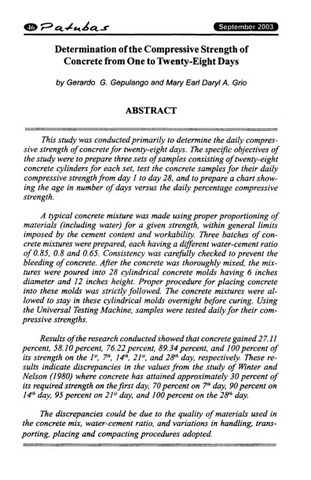
This study was conducted primarily to determine the daily compressive strength of concrete for twenty-eight days. The specific objectives of the study were to prepare three sets of samples consisting of twenty-eight concrete cylinders for each set, test the concrete samples for their daily compressive strength from day 1 to day 28, and to prepare a chart showing the age in number of days versus the daily percentage compressive strength.
A typical concrete mixture was made using proper proportioning of materials (including water) for a given strength, within general limits imposed by the cement content and workability. Three batches of concrete mixtures were prepared, each having a different water-cement ratio of 0.85, 0.8 and 0.65. Consistency was carefully checked to prevent the bleeding of concrete. After the concrete was thoroughly mixed, the mixtures were poured into 28 cylindrical concrete molds having 6 inches diameter and 12 inches height. Proper procedure for placing concrete into these molds was strictly followed. The concrete mixtures were allowed to stay in these cylindrical molds overnight before curing. Using the Universal Testing Machine, samples were tested daily for their compressive strengths.
Results of the research conducted showed that concrete gained 27.11 percent, 58.10 percent, 76.22 percent, 89.34 percent, and 100 percent of its strength on the 1st, 7th, 14th, 21st, and 28th day, respectively. These results indicate discrepancies in the values from the study of Winter and Nelson (1980) where concrete has attained approximately 30 percent of its required strength on the first day, 70 percent on 7th day, 90 percent on 14th day, 95 percent on 21s' day, and 100 percent on the 28th day.
The discrepancies could be due to the quality of materials used in the concrete mix, water-cement ratio, and variations in handling, transporting, placing and compacting procedures adopted.
Description
Journal article
Associated Content
Research reportSuggested Citation
Gepulango, G. G., & Grio, M. E. D. A. (2003). Determination of the compressive strength of concrete from one to twenty-eight days.Type
ArticleISSN
1908-515XSubject(s)

Collections
- Journal articles [17]
- Patubas [110]
Related items
Showing items related by title, author, creator and subject.
-
Development of computer program for the design of spread footing, axially loaded square column, and simply supported singly-reinforced concrete beam
(2001)The special project shall develop a program that would design commonly used reinforced concrete structures such as simple beam, column and isolated foundation footings. The language of programming to be used shall be Visual ... -
A comparative analysis of strength and cost of precast ferrocement reinforced concrete slab and conventional reinforced concrete slab
(2001)Reinforced concrete is the most common and very popular construction material being used in the Philippines. The ingredients of reinforced concrete - cement, aggregates, water and other admixtures are sourced locally and ... -
Determination of the compressive strength of concrete from one to twenty-eight days
(Central Philippine University, 2000-01)This research paper is presented in order to address the problem of determination of the compressive strength percentage requirement of concrete from the first day it was mixed until the twenty-eighth day. Concrete samples ...