
Ipakita ang simpleng tala ng item
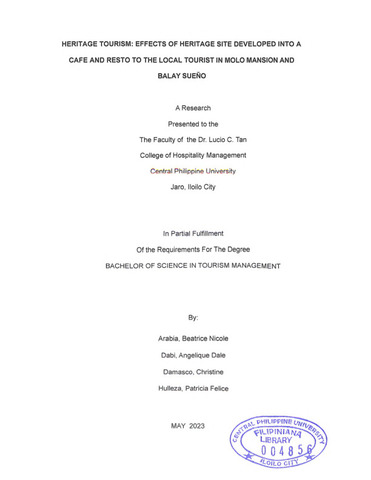
Heritage tourism: Effects of heritage site developed into a cafe and resto to the local tourist in Molo Mansion and Balay Sueño
| dc.contributor.adviser | Tan, Denie Erwin | |
| dc.contributor.adviser | Pilien, Dianne Hope M. | |
| dc.contributor.author | Arabia, Beatrice Nicole | |
| dc.contributor.author | Dabi, Angelique Dale | |
| dc.contributor.author | Damasco, Christine | |
| dc.contributor.author | Hulleza, Patricia Felice | |
| dc.date.accessioned | 2025-03-04T08:20:13Z | |
| dc.date.available | 2025-03-04T08:20:13Z | |
| dc.date.issued | 2023-05 | |
| dc.identifier.citation | Arabia, B. N., Dabi, A. D., Damasco, C., & Hulleza, P. F. (2023). Heritage tourism: Effects of heritage site developed into a cafe and resto to the local tourist in Molo Mansion and Balay Sueño [Unpublished bachelor's special paper]. Central Philippine University | en_US |
| dc.identifier.uri | https://hdl.handle.net/20.500.12852/3139 | |
| dc.description | Abstract only | en_US |
| dc.description.abstract | This study aims to determine the effect of the development of heritage sites into cafes and restos among the local tourists in Molo Mansion and Balay Sueño. The study was conducted during the school year 2022-2023. The researchers used a descriptive research design using the survey method. The researchers administered a researcher made questionnaire to 50 respondents from Balay Sueño and Molo Mansion. The data shows that converting heritage properties into cafes and restaurants has a positive impact on site management, atmosphere, service, food quality, and beverage quality. Heritage sites play an important role in preserving and providing access to heritage site materials, and digitizing this collection has become an essential task in fulfilling this function. This can be attributed to increasing and changing practical challenges as well as greater social awareness about heritage conservation. The research will enable stakeholders involved in heritage management to better understand the meaning of heritage responsibilities and promote sustainable heritage tourism development. It investigates the impact of developing heritage sites into cafes and restaurants on local tourism. The study focuses on a quantitative analysis of a local town's historic site that has been converted into a cafe and restaurant. 50 local tourists who visited the place were surveyed to gather the data. The results show that converting historic structures into cafes and restaurants boosts local tourism by boosting the number of visitors and the amount of money made. Visitors had a deeper understanding of the location's historical value, and people delighted in preserving their culture through food. However, worries were expressed about how promotion could undermine the site's credibility. Through careful planning and community involvement, the study shows how historical preservation and economic development can exist together. | en_US |
| dc.format.extent | viii, 110 leaves | en_US |
| dc.language.iso | en_US | en_US |
| dc.subject.lcc | G 155 .A1 .A73 2023 | en_US |
| dc.subject.lcsh | Heritage tourism | en_US |
| dc.subject.lcsh | Historic sites | en_US |
| dc.subject.lcsh | Bars (Drinking establishments) | en_US |
| dc.subject.lcsh | Tourists | en_US |
| dc.subject.lcsh | Historic sites--Management | en_US |
| dc.title | Heritage tourism: Effects of heritage site developed into a cafe and resto to the local tourist in Molo Mansion and Balay Sueño | en_US |
| dc.type | Special paper | en_US |
| dcterms.accessRights | Limited public access | en_US |
| dc.description.bibliographicalreferences | Includes bibliographical references | en_US |
| dc.contributor.committeemember | Giner, Shiman G. | |
| dc.contributor.committeemember | Hisuan, Armando M. Jr. | |
| dc.contributor.department | College of Hospitality Management | en_US |
| dc.description.degree | Bachelor of Science in Tourism Management | en_US |
| local.subject | Molo Mansion | en_US |
| local.subject | Balay Sueño | en_US |