

Search
Now showing items 1-10 of 10
Use of blue ternate (Clitorea ternatea Linn.) and karonda (Carissa carandas Linn.) fruit and flower extract as alternative bacterial stain
(2022-08)
It has been known that bacterial staining is one of the fundamental procedures done when identifying microorganisms, hence, learning about it and obtaining skills to perform it has been given great importance. This activity led to the constant exposure of the students and researchers, alike, to the chemicals used to achieve results. The chemicals used, or in this case, the dyes, were synthetic in nature, thus they pose possible danger to those who are continuously using it. The purpose of this study is to determine the possibility of karonda (C. carandas) fruit and blue ternate (C. ternatea) flower crude extracts as alternative bacterial stains by observing their staining intensities on S. aureus. Methylene blue served as the positive control. Tannic acid was added as a mordant to the crude extracts and staining intensity was based on the Likert scale. Results showed that blue ternate flower had a mean score of 0.8 (low staining intensity), blue ternate with tannic acid had a mean score of 1.8 (average staining intensity) while karonda fruit crude extract had a mean score of 1.0 (low staining intensity), karonda with tannic acid had 1.2 (average staining intensity) compared to the control group which had a mean score of 3.0 (very high staining intensity. This means that the staining intensity of the crude extracts obtained from natural sources were way beyond the staining intensity of methylene blue which is of synthetic origin....
Antibacterial activity of balloon vine (Cardiospermum halicacabum L.) leaf and fruit crude extracts, and their combination against Staphylococcus aureus
(2022-08)
Staphylococcus aureus the leading cause of bacterial infections in hospitals and communities such as abscesses (boils), furuncles, and cellulitis is a major pathogen of increasing importance due to the rise in antibiotic resistance. Cardiospermum halicacabum a well-known plant was investigated to explore its capacity against bacterial activity such as S. aureus that would be useful in the production of compounds that can inhibit other pathogenic bacteria and other pathogenic microorganisms. This study attempted to extend such concept and explore the possibility of using halicacabum as possible agent in controlling human pathogens specifically the aureus. The mean (M) was used in order to determine the average zone of inhibition of aureus applied with balloon vine (C. halicacabum) leaf, fruit, and combined extracts, Amoxicillin (Positive control), and Ethanol (Negative control). Using the disc diffusion method, the crude extract of C. halicacabum showed that the greatest zone of inhibition of S. aureus was observed among those applied with Amoxicillin (M= 52mm), followed by those applied with balloon vine fruit extract (M=44mm) Both leaf extract (M=31mm and the combined leaf and fruit extract (M=30mm) also significantly exhibited inhibition against the S. aureus. There is no zone of inhibition observed among those applied with Ethanol (M=.00mm). The One-Way ANOVA test result shows that the p-value is .000 which is deemed to be statistically significant if p<.001....
Extraction and characterization of collagen from red snapper (Lutjanus spp.) scales
(Central Philippine University, 2025)
The increasing demand for sustainable and alternative collagen sources has led to a focus on fish by-products, particularly fish scales, as viable materials for collagen extraction. In this study, collagen was extracted ...
Phytochemical screening and antibacterial efficacy of Musa acuminata x balbisiana (saba banana) peel crude ethanolic extract against meat spoilage-causing bacteria
(Central Philippine University, 2025-03)
<i>Musa acuminata x balbisiana</i> (saba banana) is a perennial herbaceous plant that has high phytochemical content in its different plant parts. However, 15-60% of its fruit remains underutilized. Banana fruit peels which ...
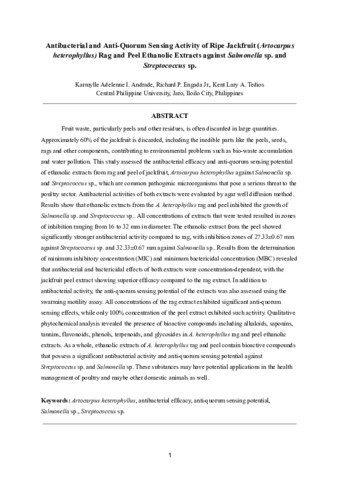
Antibacterial and Anti-Quorum Sensing activity of ripe jackfruit (Artocarpus heterophyllus) rag and peel ethanolic extracts against Salmonella sp. and Streptococcus sp.
(Central Philippine University, 2025-04)
Fruit waste, particularly peels and other residues, is often discarded in large quantities. Approximately 60% of the jackfruit is discarded, including the inedible parts like the peels, seeds, rags and other components, ...
Formulation and evaluation of liquid hand soap incorporating Plectranthus scutellarioides (Mayana) leaf ethanolic extract against Staphylococcus aureus
(Central Philippine University, 2024-12)
This study aimed to evaluate the antibacterial activity of liquid hand soap formulated with varying concentrations of <i>Plectranthus scutellarioides</i> (Mayana) leaf ethanolic extract against <i>Staphylococcus aureus. ...
Antioxidant potential of ethanolic extracts of mango (Magnifera indica) peels at different ripeness levels
(Central Philippine University, 2025-05)
Mangoes are not only delicious and widely consumed tropical fruits, but they are also a rich source of antioxidant compounds, particularly vitamins C and A. These antioxidants play a crucial role in protecting the body’s ...
Comparative evaluation of antibacterial activity of ethanolic extracts of peels of unripe, partially ripe, and fully ripe mangoes (Mangifera indica) against Escherichia coli and Staphylococcus aureus
(Central Philippine University, 2025-05)
Amid rising concerns over antimicrobial resistance, plant derived bioactive compounds are increasingly studied for their therapeutic potential. This study evaluated the antibacterial activity of ethanolic extracts obtained ...
Insecticidal properties of miracle fruit (Crescentia cujete) leaves against mosquito larvae
(Central Philippine University, 2025)
Mosquito-borne diseases remain a major public health concern globally, with mosquitoes being the primary vector of dengue, Zika, Chikungunya, and Yellow fever. In response to increasing resistance to synthetic larvicides ...
Anthelmintic activity of wild chili pepper (Capsicum frutescens Linnaeus) fruit ethanolic extract against Ascaridia galli
(Central Philippine University, 2024-12)
This study was conducted to evaluate the in vitro anthelmintic activity of wild chili pepper <i>(Capsicum frutescens L.)</i> fruit extract against <i>Ascaridia galli,</i> a common gastrointestinal parasite in native chickens. ...