

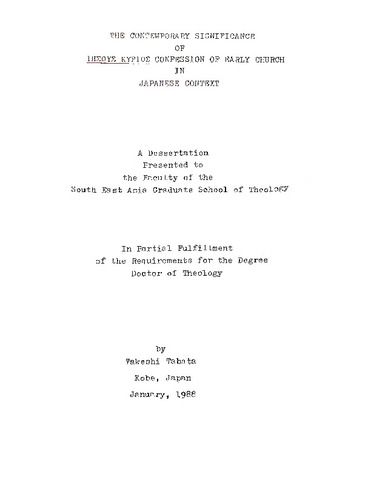
The contemporary significance of IHΣΟΥΣ ΚΥΡΙΟΣ confession of early church in Japanese context
Résumé
* 1 лб〇v3s Kup t〇g was very simple in form, but a basic confession which supported and strengthened the life of early Church. It is still valid and indispensable confession, especially, to the Japanesee Christians who have had the painful history of failing in the confrontation with the Tenno fascism in pre-wartime. They chose the way of compromising, and therefore, that of submissive to the evil powers. The same grave mistake should never be re peated again. To prevent the same mistake, it is necessary to re-examine the importance of Iesous Kurios confession in the New Testament. Then the correct application of it should be done to contemporary Japanese situations.
In the New Testament various titles or names are used of Jesus. These are inseparably connected with the remarkable event of His resurrection. This event gave a new dimension to the person of Jesus. The previous titles (Teacher, Prophet, etc.,) became outdated and new ones had to be found. And among them the title "Lord"(Kurios) became the commoner title of Jesus. And it Ъесате to play very important role in the life of early Church.
The title was used among the first Jewish Christians, as is proved by the Aramaic form of Church's prayer, "Marana tha! Our Lord, come!"(I Cor. 16:22). And when Christianity spread into the Hellenistic world, the title "Lord" won a much wider currency.
The first Christians were convinced with this Iёsous Kurios confession that Jesus was an only Savior, the head of His community, and also that of the whole world.
The confession played very important roles in "the various situations of the early Church, that is, in the liturgical context, as the heart of kerugma,as the basis of didache, and as an apologia. Thus the confession was the Life itself, of the first Christian communities.
The history of the early Church was that of martyrdom. It was really put into the fiery trials. But it kept its confession, for three centuries.
Worship the Lord Caesar and gods in Rome! - It was the Roman law. Against this order Christians answered with a very simple witness or confession: "I am a Christian." With this witness or confession they expressed clearly their only true Master, Lord to whom they had to offer worship and obey. They were criticized and condemned as "anti- Roman,” "unpatriotic" and "atheist," etc. They had to live under the judgement of "non licet vos," and were scorned or oppressed by a succession of emperors, bearing all trials with a fierce tenacity, multiplying quietly, building or der while their enemies generated chaos, fighting the sword with the word, brutality with hope, and at last defeating the strong estate that history has known. Thus they got the freedom, the freedom not only for them, but also for the whole world overcoming the evil authority. Here is found the victory of confessing Church and confessing Christians.
How did the Christian Church and Christians in Japan live in pre-wartime, especially, during World War II? It is symbolized by the formation of the Kyodan. It was forced to walk on the course which was controlled by strong imperialism. Any movement which seemed, to be against "kokutai" (national structure), the cardinal principle of which was the worship of the Emperor, was completely oppressed. The arrest of the Holiness group people who had emphasized the second coming of Christ), and the pacifist pastors and people, was a sign of the terrible era.
Except only a few who maintained a clear witness as Christians, the Church in Japan cooperated with the State and the military during wartime. It lacked the correct understanding of the Lord- ship of Jesus in the Biblical sense. And its theology was of no use.
In Europe the strong storm of Nazism blew furiously from 1933. In such a situation the Church Struggle (Kirchenkampf) began. In Germany, Norway and Netherland Churches started their resistance against the evil authority. They stood on the confession of the Lordship of Jesus, and it was the secret of the struggle toward victory. In each country the confessing Church tried to be the conscience of the nation. Here is found the significance of their struggles, and it is a precious inheritance left for the whole Christendom. In Norway the doctrine of the Two Kingdoms was of no use.
Japan finally surrendered, and a completely new era seemed to come. A new constitution which emphasized the abandonment of mil- itary power, was established, and the Emperor's deity was renounced. Freedom was acquired. But as a proverb says: "Nodomoto sugireba atsusa o wasureru" (Danger past, God forgotten), Japan has begun to walk on the same road, the dangerous road as it had walked. The restoration of the ideology of the centrality of the Imperial House, the strengthening of military power, and the nationalization of Yasukuni Shrine are main signs of going back ward.
Against such a situation the Churches in Japan are not silent. They have become more and more aware of their guilt, especially, during war years, and their responsibility. They have begun to fight against the revival of the Tenno system ideology, Yasukuni Shrine problem and for peace, etc. The importance of reconsideration of the Lordship of Jesus has been emphasized among Christians. It is necessary indeed not to repeat the same confession. When our country committed sin, we Christians too shared the same sin. From the depth of our heart's pain, we confess this sin and ask the pardon our Lord, and the people of the world, especially of the Asian countries as well as our own people.
In Japan Christians are still minority, and Churches have several weak points. But the Japanese Christians should not be pessimistic. They must be much more trained and strengthened to be militant Christians to do the will of God which is directed always for love, peace and righteousness. Where there is right understanding of the Lordship of Jesus and also that of the discipleship and where there is the actual practice of it, however difficulties it may encounter, there will be opened the bright future for the Churches in Japan.
Description
Abstract only
Suggested Citation
Tabata, T. (1988). The contemporary significance of IHΣΟΥΣ ΚΥΡΙΟΣ confession of early church in Japanese context [Unpublished doctoral dissertation]. South East Asia Graduate School of Theology.
Type
DissertationSujet

Department
South East Asia Graduate School of TheologyDegree
Doctor of TheologyShelf Location
BT 212 .T33 1988
Physical Description
viii, 277 leaves
Collections
- Doctor of Theology [38]