

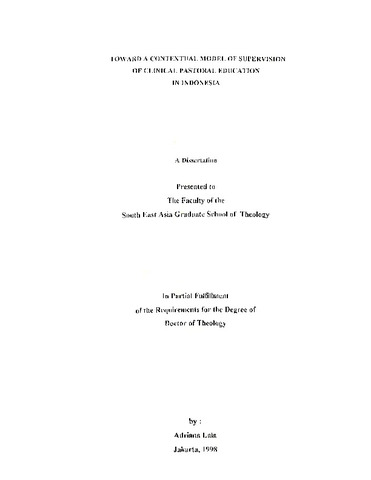
Toward a contextual model of supervision of clinical pastoral education in Indonesia
Аннотации
For more than two decades, the search for new methods for Theological Education in Indonesia, has emerged. Pastoral Education as an integral part of Theological Education, is considered important in preparing ministers for the ministry, yet it needs to be enhanced a properly developed. This study is an attempt to respond to the need, seeking to arrive at a model for Clinical Pastoral Supervision in Indonesia.
The dissertation directly flows out of two units of Clinical Pastoral Education held at Cikini Hospital Jakarta, based on supervisory experience with a variety of individuals, female and male, with a wide spectrum (from 25 to 60 years old), from regions such as North Sumatera, Jawa. Maluku, North and South Sulawesi. The participants consist of pastors, theological students, paramedical, social worker, teachers, with Protestant and Roman Catholic backgrounds, including a Catholic sister.
As methodology, qualitative research method is utilized. This approach is inductive in nature and requires many hours of depth interviews and extensive reporting. The qualitative research method avoids a clear prior hypothesis. Here, therefore, we start with a general research interest, such as in this case: a contextual model for supervision. The hypothesis comes naturally out of the research.
The actual research focus is yielded in the process of sifting the material and drawing lines between the stories, that is, the participants/the students: the living human documents. The first and the primary resource of this study, then, is the living human documents.
This being a theological study methodology is based on the presupposition that human experience and the analysis of the experience has theological value. Two principles have given us the basis, namely:
- Viewing the person as a holistic being
- Noting the bi-polar aspect of pastoral care, in which both God's revelation and human experience are seen as meaningful.
By acknowledging this bi-polar perspective theology as a discipline and other sciences as well are used particularly in discussing the issues in supervision.
The writing continues as follows:
First: introducing the history and basic principles of Clinical Pastoral Education; the shape of the two programs at Cikini Hospital and the participants.
Second: Systematic description and analysis of the experience of the participants in relation to supervision.
Third: Interpretation: The important Issues of Supervision, consist of: Issues of Clinical Learning and Obstacles that hinders the process of Clinical Learning such as: Communication, (Personal) Wounds, and Power.
Fourth: Theological Reflection on Communication. Wounds/Sufferings and Power. Incarnational theology overcomes the obstacles. Communication should enable healing, growth and wholeness. Wounds become a source of healing, growth and wholeness. Power should be used only to empowering the learning process of the participants.
Fifth: From this study we come to the conclusions:
1. Supervision is the primary catalyst in the Clinical Pastoral Education. As the primary catalyst, supervision facilitates an integrative process of clinical learning of the participant as holistic human being.
2. The research showed that supervision is relational. From the record of Supervision with each of the six participants in chapter 2 and 3. Shows that the problems faced by the participants in the clinical learning should be seen in the relational context: the participant with him/herself, with the peer groups, with the supervisor and with the patients/ families they serve.
3. The research showed that Communication. Personal Wounds/Sufferings and Power are obstacles to the process of Clinical Learning. And. therefore, some suggestions for the next program, these following issues should be taken into consideration: The participants need to have: Communication contracts. Power/Competence contracts (including supervisor), and contracts to give way to openness in relating their wounds/sufferings in the supervisory session.
4. Based on the research, the supervisor should develop some basic helping skills, such as:
a. an ability to establish a relationship with the participant.
b. an ability to accept participant in a non-judgmental way.
c. an ability to attend to the participants internal world of feeling: an ability to respond empathically to the participant.
d. an ability to formulate a “diagnostic skills” based on the assessment of the facts.
e. an ability to use “wounded healer skills”
f. an ability to utilize “holistic skills”
g. an ability to attend to the participant’s internal world of feeling; an ability to respond empathically to the participant.
Finally, we come to the proposed contextual model of Supervision of Clinical Pastoral Education in Indonesia
Описание
Abstract only
Suggested Citation
Lala, A. (1998). Toward a contextual model of supervision of clinical pastoral education in Indonesia [Unpublished doctoral dissertation]. South East Asia Graduate School of Theology.
Type
Dissertation
Department
South East Asia Graduate School of TheologyDegree
Doctor of TheologyShelf Location
BT 212 .L35 1998
Physical Description
viii, 269 leaves
Collections
- Doctor of Theology [37]