

Knowledge, skills, and readiness for artificial intelligence integration in nursing practice among special area nurses
Abstract
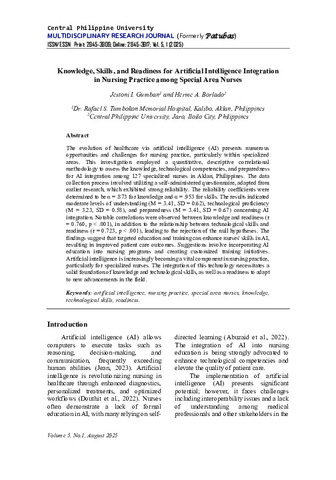
The evolution of healthcare via artificial intelligence (AI) presents numerous opportunities and challenges for nursing practice, particularly within specialized areas. This investigation employed a quantitative, descriptive correlational methodology to assess the knowledge, technological competencies, and preparedness for AI integration among 127 specialized nurses in Aklan, Philippines. The data collection process involved utilizing a self-administered questionnaire, adapted from earlier research, which exhibited strong reliability. The reliability coefficients were determined to be α = .873 for knowledge and α = .953 for skills. The results indicated moderate levels of understanding (M = 3.41, SD = 0.62), technological proficiency (M = 3.23, SD = 0.58), and preparedness (M = 3.41, SD = 0.67) concerning AI integration. Notable correlations were observed between knowledge and readiness (r = 0.760, p < .001), in addition to the relationship between technological skills and readiness (r = 0.723, p < .001), leading to the rejection of the null hypotheses. The findings suggest that targeted education and training can enhance nurses' skills in AI, resulting in improved patient care outcomes. Suggestions involve incorporating AI education into nursing programs and creating customized training initiatives. Artificial intelligence is increasingly becoming a vital component in nursing practice, particularly for specialized nurses. The integration of this technology necessitates a solid foundation of knowledge and technological skills, as well as a readiness to adapt to new advancements in the field.
Description
Journal article
