
DGI'S road to unity
| dc.contributor.adviser | Holtrop, P.N. | |
| dc.contributor.author | Ngelow, Zakaria Jusuf | |
| dc.date.accessioned | 2026-05-29T04:04:52Z | |
| dc.date.available | 2026-05-29T04:04:52Z | |
| dc.date.issued | 1982 | |
| dc.identifier.citation | Ngelow, Z. J. (1982). DGI'S road to unity [Unpublished master's thesis]. South East Asia Graduate School of Theology. | en_US |
| dc.identifier.uri | https://hdl.handle.net/20.500.12852/3846 | |
| dc.description | Abstract only | en_US |
| dc.description.abstract | The (Protestant) churches of Indonesia began to stand as independent churches half century ago. This very young Christianity not only struggled to consolidate itself after experiencing various challenges during World War II, but also became directly involved in the movement for the unity of the churches. At the end of the beginning of this movement the churches of Indonesia decided to form "The United Christian Church in Indonesia", and it was agreed to set up the DGI, Council of Churches in Indonesia, as a "place for discussion and cooperation for the churches with a view to unity ..." The formation of this body for unity was supported by various factors, including the ecumenical movement throughout the world, the history of evangelism and church growth, in Indonesia, and the Indonesian national movement. The DGI undertook this noble task more than 30 years ago, but the ideal of unity cannot yet be achieved. Indeed the DGI as been struggling with it. Until 1964 the DGI tried to bring about uniformity, the content of unity which was decided on after the DGI was formed. After they became conscious that this concept was erroneous, they struggled with a new content and vision of unity, i.e. “unity in diversity", by compiling a draft constitutions of the Ecumenical Synod of Churches in Indonesia. It did not succeed. Then, since 1971 the PGI has, as it were begun again from below. Consultation were held, work teams formed, new vision developed, and the means of getting-down to work improved. As a follow-up to all this the most recent General Assembly of DGI in Tomohon, 1980, decided on a crash programme: "so that in four years' time the DGI and churches will truly be used to compile together and carry into effect, concrete programmes in stages, at the local, regional and national levels, in order to prepare for the formation of One United Christian Church at the 10th General Assembly of DGI." Study of the efforts of DGI (and the Indonesian churches) to form one United Church in Indonesia shows that the Indonesian churches must still be patient for a long time and do a great deal, as well as committing themselves more firmly to the Lord, the Head of the Church, before the ideals of unity are realized. M. de Niet, one of the pioneers of the movement for church unity in Indonesia, pointed out at a missionary conference in 1946: "One truly Indonesian Christian Church cannot be formed by a group of people or on human authority overnight or with acclamation or a majority vote. That Church must grow by the grace of God, and will do so, although its results will possibly be different from what the Christians who thinking more or less ecumenically and the leaders of churches and missionary have truly struggled to achieve. | en_US |
| dc.format.extent | 152 leaves | en_US |
| dc.language.iso | other | en_US |
| dc.publisher | South East Asia Graduate School of Theology | en_US |
| dc.subject.lcc | BT 212 .N44 1982 | en_US |
| dc.subject.lcsh | Christianity | en_US |
| dc.subject.lcsh | Christian union--Protestant churches | en_US |
| dc.subject.lcsh | Church growth | en_US |
| dc.subject.lcsh | Church--Unity | en_US |
| dc.subject.lcsh | Ecumenical movement | en_US |
| dc.subject.lcsh | Protestant churches | en_US |
| dc.title | DGI'S road to unity | en_US |
| dc.type | Thesis | en_US |
| dcterms.accessRights | Limited public access | en_US |
| dc.description.bibliographicalreferences | Includes bibliographical references | en_US |
| dc.contributor.department | South East Asia Graduate School of Theology | en_US |
| dc.description.degree | Master of Theology | en_US |
| local.subject | The United Christian Church in Indonesia | en_US |
Files in this item

This item appears in the following Collection(s)
-
Master of Theology [75]
Related items
Showing items related by title, author, creator and subject.
-
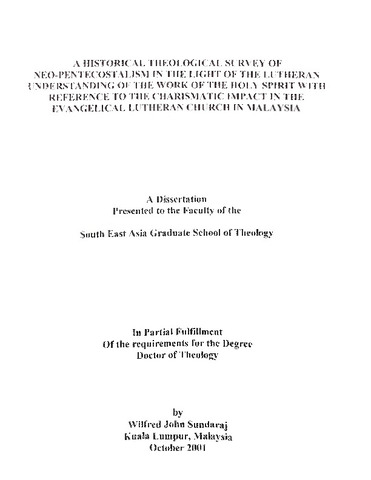
A historical theological survey of neo-Pentecostalism in the light of the Lutheran understanding of the work of the holy spirit with reference to the charismatic impact in the Evangelical Lutheran Church in Malaysia
(South East Asia Graduate School of Theology, 2001-10)The objective of this dissertation is to make a historical and theological analysis of neo-Pentecostalism, in the light of the Lutheran understanding of the work of the Holy Spirit, with reference to the charismatic impact ... -
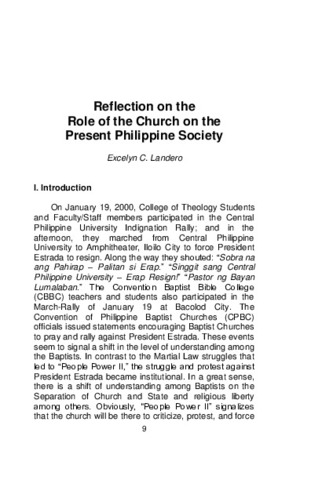
The role of the Church on the present Philippine society
(Institute of Advanced Theological Studies (IATS) and College of Theology, 2005)On January 19, 2000, College of Theology Students and Faculty/Staff members participated in the Central Philippine University Indignation Rally; and in the afternoon, they marched from Central Philippine University to ... -
A model text for education & caring new family members of growing church
(2000-02)The thesis is aimed at looking into development of teaching materials for the new believer’s care and education. Every pastor’s саn't help thinking of church growth. Generally we say that the missions of church are two ...