

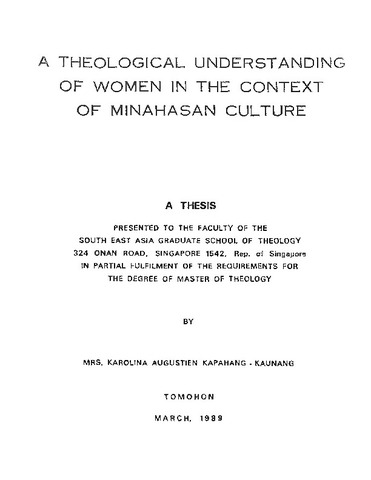
A theological understanding of women in the context of Minahasan culture
摘要
One of the major movements in recent theological debate around the world has been that of feminist theology. This has opened up the whole question of a theological understanding of women. Although largely beginning in the United States of America, this question lies at the centre of much theological discussion all over the world.
The aim of this thesis is to test its validity in a particular Indonesian culture. The particular culture is that of the Minahasa, on the North-East tip of the island of Sulawesi (Celebes) in Eastern Indonesia, This culture is significant because, although it has long been Christianised at least in a superficial way, it still presents the dynamics of its pre-Christian culture in many aspects of its life.
The methodologies used include historical and field research in relation to Minahasan Society, and library research in relation to the current debate around a theological understanding of women (Introduction).
After the Introductory Chapter I, in Chapter II the context of Minahasan culture for investigating a theological understanding of women is dealt with. After a general introduction to both Minahasan culture and Minahasan Christianity, there is a detailed discussion of the main sources for an understanding of women in Minahasan Society. First, there is an analysis of the various versions of the central self-identification myth of Minahasan Society, the Toar Lumimuut myth. Second, there follows an analysis of Minahasan language use. Third, there is an analysis of various aspects of Minahasan customary law. Various conclusion are reached, showing in general that there is a need for harmony between men and women and in particular that the difference in value between the sexes in Minahasan Society, both pre-Christian and Christian, is very limited indeed.
In Chapter III, an analysis is carried out of modern feminist Biblical reflection and modern feminist theology. First, the recent writings of major Western feminist theologians, such as Elisabeth Schussler Fiorenza, Letty M. Russell and others is discussed against the historical background of the movement for women's theology. Second, there is a similar analysis of major Asian women's Biblical and theological writings. Third, there is a particular analysis of Indonesian women's theological and Biblical reflections. A variety of conclusions are drawn, showing in general the need for a radical renewal of Biblical and theological writings from a newly-liberated feminist viewpoint.
In Chapter IV, there is a theological reflection on the material in Chapter II, in relation to the themes of Chapter III. It is demonstrated that the pre-Christian and Christian understanding of women in the Minahasa by coincidence is not far from that shown in the New Testament, both in the radical approach of Jesus and in the explanations of Paul. Sexuality is not a primary differentiation point in both Minahasan Society and major New Testament themes, the latter set against the background of liberation from Old Testament scriptures.
In the concluding Chapter V it is demonstrated, as a result of the theological reflection in Chapter IV, that major elements in the feminist theological debate, particularly in the West, may in fact raise, in an unhelpful way, issues which have been settled along strongly New Testament lines in Minahasan Society. Thus the Western debate, if transferred to Minahasan Society, would in fact be a theological retreat rather than a theological advance. The present "advanced" Minahasan position is demonstrated in a variety of practical examples. This position needs to be further developed, rather than undermined by a debate essential in many Western countries, but irrelevant and unhelpful in Minahasan Society. Thus, once again the whole issue of the problem of translating theology from one cultural background to another and of the importance of the contextual theology is raised.
描述
Abstract only
建议引文
Kaunang, K. A. K. (1989). A theological understanding of women in the context of Minahasan culture [Unpublished master's thesis]. South East Asia Graduate School of Theology.
文件类型
Thesis主题

部
South East Asia Graduate School of Theology学位
Master of Theology货架位置
BT 212 .K38 1989
物理描述
166 leaves
集合
- Master of Theology [73]