

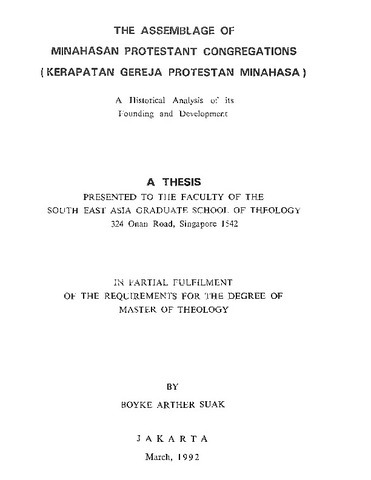
The assemblage of Minahasan Protestant Congregations (Kerapatan Gereja Protestan Minahasa): A historical analysis of its founding and development
Abstract
This is a writing on a church in Minahasa, called 'KGPM' (Kerapatan Gereja Protestan Minahasa = Assemblage of Minahasan Protestant Congregations). The church was organized on April 21, 1933.
The writing is to analyze historically its founding and development. Besides, it is hoped that the need of this church of a more profound and directed study on its history, will be met.
The background of the founding of this church was closely related to the attempts of Minahasan Christian groups to reorganize the Protestant Church in the Netherlands' Indies (here-after : PCNI) in Minahasa to become a self-governing church. These attempts, which had been initiated since the end of the 19th century, became more crucial in the beginning of the 20th century. Since the attempts caused the tension between the church ministers in Minahasa, namely between those of the Netherlands' Missionary Society and of the PCNI, administrative boards of both sides, then, tried together to find a way out to overcome the tension. In result, in the middle of 1920-s, the Administrative Board of the PCNI organized a 'Commission of Twelve' to reorganize the church in Minahasa.
However, the commission failed to settle the difference of opinions on how the self-governing church Minahasa should be organized. In effect, in there were two groups of Minahasan Christians attempting separately to reorganize the church in Minahasa.
The first group, the Commission of Twelve, proposed a self-governing church in Minahasa as a church within the organization of the PCNI. In fact, such a proposal, which still placed the church in Minahasa under the control and arrangement the Dutch, was supported and agreed by the administrative board of the PCNI. The second group proposed the self-governing church as an autonomic church — led by Minahasan Christians and becoming their responsibility, thus freed from the dominion of the Dutch. The proposal of this last group was supported by most of the leading Minahasan figures.
The attempts of the last group to reorganize the self-governing church based on its proposal were aimed at getting the agreement of the administrative board of the PCNI and the government. But the group did not succeed. As a consequence, it took its own way to accomplish the self- governing church according to its view, namely to found KGPM as a church untied to the PCNI and to the colonial government. The founding of the church was a protest caused by the attitude and the unwillingness of the administrative board of PCNI to trust the indigenous people with the leadership of the Protestant Church in Minahasa.
As an independent church, led and arranged by indigenous people, the first attempt pursued by the board of KGPM was to create a cooperative relationship between KGPM and the PCNI. But, since the existence of KGPM was considered illegal by the PCNI and the government, the attempt of KGPM was in vain. Conversely, PCNI sought to freeze the activities of KGPM, especially because KGPM was considered motivated by political goals.
The failure of KGPM to create a cooperative relationship with the PCNI, forced the church (KGPM) to pay attention to the congregations of the PCNI in Minahasa which were willing to associate and to be part of KGPM. The first one was the congregation of the village of Wakan, inaugurated by the board as a congregation of KGPM on October 29, 1933. By the inauguration of this congregation, the board of KGPM made an official announcement about its new attitude, namely: since then KGPM would not any longer get in touch with the PCNI, in whatever case. From this time on, KGPM went on to develop and until now serves its own congregations, in and outside Minahasa (Jakarta, Bolaang Mongondow and Siau-Tagulandang).
As for the form of church administration, KGPM, in the beginning, submitted to 'congregationalisme'. Even so, in operation, KGPM at the moment does not follow the rules of the system. Now, KGPM is rather applying a form of church administration which is more colored by a central leadership. Something which is typical to the structure of KGPM is that there are two boards of leadership, namely: a board of organisatory each board has its own role in determining the existence of KGPM. In the case of doctrine and worship, there never was any difference between KGPM and the PCNI.
Also discussed in this writing are the role and activities of KGPM as a witnessing and ministering church in the period of both before and after the independence of Indonesia. In this section, the writer tries to put down a critical evaluation on several matters which have often arisen as problems and misunderstandings in KGPM, historically and theologically. Those matters are, among others, the history and the date of the founding of KGPM, and the form of structure and the system of administration of KGPM. Illuminated, too, are several problems faced, by KGPM on its attempts to do its work and to intensify its tasks and responsibilities in various fields of church ministry.
Finally, a kind of reflection will be given on understanding of the task and responsibility of KGPM in the future, oriented to the main struggles faced by this church nowadays.
Description
Abstract only
Suggested Citation
Suak, B. A. (1992). The assemblage of Minahasan Protestant Congregations (Kerapatan Gereja Protestan Minahasa): A historical analysis of its founding and development [Unpublished master's thesis]. South East Asia Graduate School of Theology.
Type
ThesisSubject(s)

Keywords
Department
South East Asia Graduate School of TheologyDegree
Master of TheologyShelf Location
BT 212 .S83 1992
Physical Description
xi, 342 leaves
Collections
- Master of Theology [73]