

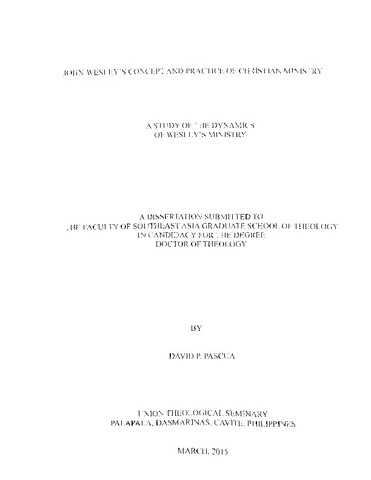
John Wesley's concept and practice of Christian ministry: A study of the dynamics of John Wesley's ministry
Abstract
This is a work in the area of Practical Theology, most specially, the subject of administering a local church. It is offered as a long-term response to an urgent need in our church which is going through a crisis right now. The context that it addresses is chronic. Therefore, the response offered is meant to be implemented on a long term basis. I am sure that if adopted and followed, the local church will be renewed and revitalized.
Over years, the church has not given careful attention to its own distinctive teachings. Consequently, the discipline and practice of the church have been neglected. There is confusion about how the Christian ministry is to be done at a local church level, which is that level at which the church is in contact with the world. The confusion is marked by what this writer calls “split Methodism’s where it should be" conjunctivist". Because of some confusion in teachings, and the liberal attitude that developed over the years, any church in this kind of predicament will face the world from a position of weakness.
What this study offers is food for anyone who is at a crossroad: a passionate urging to revisit our rich heritage of theology and ministry.
More specifically, the writer studied John Wesley's concept and practice of Christian ministry because it offers a comprehensive system that touches the whole life and work of the church, including its doctrinal emphases, its discipline, and its practice. The study offers these as component parts of Wesley's concept of Christian ministry. In the writer's view, the doctrines provide the superstructure or the rationale for change, the discipline provides the structure for commitment and responsibility, and the practice translates the goal aspired for into a reality. To put it another way, doctrines define life's meaning, discipline appropriates meaning and demands that one commits one’s life to it, and practice must be present in congregational program at all times, if we want transformation to take place.
Chapter 2 is the heart of the study. This chapter discusses John Wesley's concept and practice of Christian ministry and gives a thorough discussion of its three component parts. Chapter 3 compares Wesley's concept with the concepts of ministry of three theologians, two from Asia and one from the West. The study shows that Wesley’s major difference with them is his emphasis on sanctification as the primary task of ministry. Wesley was tireless in his evangelical preaching and his excellent organizing work for the purpose of sanctification as ministry. Chapter 4 explains Wesley's Ordo Salutis as the theological pathway to personal and social transformation. Chapter 5 explains in more detail the components of discipline and practice as equally important factors in the task of transformation. Chapter 6 reconstructs Wesley's concept by expansion involving mission and evangelism, ecological justice, and Interfaith Dialogue.
I mentioned in the conclusion that Wesley's concept is a concentric of two circles: the inner circle is focused in transformative work within the life of the congregation, while the outer circle focuses in ministries where the congregation makes its influence and impact in the life of the society. Wesley conducted the mission and ministry of the Methodist movement in this balanced manner.
The writer believes that the church must adopt this concept of ministry because the concept is a means to arrive at an end, which has always defined Methodist's life and work: sanctification. John Wesley used this term, in a way that has implications for both personal and social transformation. As Methodist theology is conjunctivist, its understanding of ministry is conjunctivist as well. As a concept of Christian ministry, I am convinced that it has relevance to all churches that carry the Wesleyan heritage of theology and ministry.
Paglalarawan
Abstract only
Mungkahing Sipi
Pascua, D. P. (2015). John Wesley's concept and practice of Christian ministry: A study of the dynamics of John Wesley's ministry [Unpublished doctoral dissertation]. Southeast Asia Graduate School of Theology.
Uri
DissertationMga Paksa

Mga keyword
Kagawaran
South East Asia Graduate School of TheologyDegree
Doctor of TheologyLokasyon ng Istante
BT 212 .P37 2015
Pisikal na paglalarawan
x, 281 leaves
Collections
- Doctor of Theology [13]