

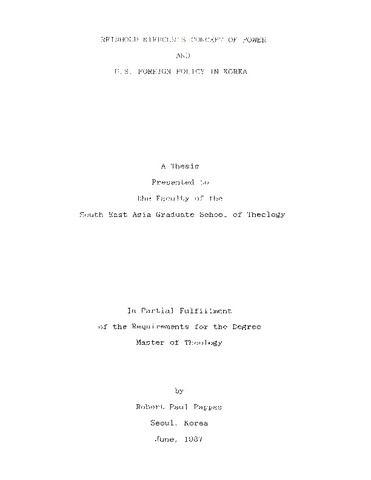
Reinhold Niebuhr's concept of power and U.S. foreign policy in Korea
摘要
Reinhold Niebuhr's Concept Of Power And : Foreign Policy In Korea is a creative effort ascertaining the validity as well as the contribution of Niebuhrian power politics in U.S. foreign policy toward Korea. The thesis is composed of five chapters: first, "The Historical Roots of Niebuhr’s Thought and His Concept of Power", second, "Niebuhr and the Marxist Ideology"; third, "Niebuhr and International Power Politics"; fourth, "U.S. Foreign Policy in Korea 1969-1987"; and fifth, "Niebuhr Reinterpreted.
Chapter one has a twofold purpose. First, it seeks to understand the contributors of Niebuhr's theological and philosophical thought. It focuses on Kierkegaard, Pascal, the reformers and finally, Augustine and Paul. By investigating these great thinkers one can better apprehend the historical roots of Niebuhr's thought, which has provided a foundation for his twentieth century ethic of power and its relation to economic and socio-political structures. The second portion of chapter one elaborates upon the Niebuhrian concept of power. Niebuhr claimed that man's individual and collective egoism is fundamental to economic and political injustice. While individual egoism can be subdued through the power of God's love, collective egoism cannot. Thus all man can hope for in the economic, political and social structures of life is a relative justice resulting from power balances.
Chapter two elaborates upon the three phases of Niebuhr's relation to the Marxist ideology. The first stage began in the third decade of the twentieth century. This was Niebuhr's pre-Marxist period as a struggling young pastor in Detroit seeking solutions to socio-economic injustices in a capitalist society. In the second stage Niebuhr found in Marxism a socio-political tool in dealing with the disproportion of economic power in a capitalist society. While he perceived in Marxism possible solutions for the working class in America, he was fully aware of the dangers inherent within Marx's religious utopianism. The final stage roughly coincides with the period before and after the Second World War. During this period Niebuhr opposed the revolutionary Marxism adopted by Communism. The final stage of Niebuhrian power politics has greatly influenced U.S. foreign policy in its historic context.
Chapter three is composed of six sections: first, Niebuhr's views concerning Communist power; second, Niebuhr and the cold war; third, Niebuhr and the Korean War; fourth, Niebuhr and Vietnam; fifth, Niebuhr and nuclear war and finally, Niebuhr and liberation theology. The primary focus within the framework of international power politics was the Niebuhrian balance of power against Communist tyranny. However, unlike patriotic, cultured theologians, Niebuhr’s realism was a creative force which enabled him to criticize as well as exonerate U.S. foreign policy in Asia.
Chapter four deals with U.S. foreign policy in Korea from 1969 to 1987. Korea has differed While U.S. foreign policy in among recent presidential administrations, two prominent themes of concern continually resurface. First, within the international realm is the ideological tension on the peninsula, which has not only provoked a "precarious peace," but essential to maintaining peace is the need for U.S. military strength in South Korea. Second, within the domestic realm is the desire of the U.S. for democratic processes in the Republic of Korea. However, there are some intellectuals within the secular and Christian communities, who not only perceive but challenge the U.S. - Soviet military presence in Korea as a threat to future peace, reconciliation and reunification of the peninsula. These individuals represent a third voice between the two superpowers in Korea. It is essential to note the tension between the Niebuhr Ian balance of power and liberation theology.
The fifth chapter is a crystallization of the validity of Niebuhr's concept of power, as it relates to the international and domestic scene in Korea. However, it is evident that Niebuhr's emphasis on power politics neglects the gospel commission to Communist societies.
It is no easy task to summarize this genius of political thought. Nonetheless, one thing is certain, his teachings are with us today, and shall continue to influence U.S. foreign policy in the years to come.
描述
Abstract only
建议引文
Pappas, R. P. (1987). Reinhold Niebuhr's concept of power and U.S. foreign policy in Korea [Unpublished master's thesis].
South East Asia Graduate School of Theology.
文件类型
Thesis主题

关键字
部
South East Asia Graduate School of Theology学位
Master of Theology货架位置
BT 212 .P37 1987
物理描述
xii, 159 leaves
集合
- Master of Theology [73]