

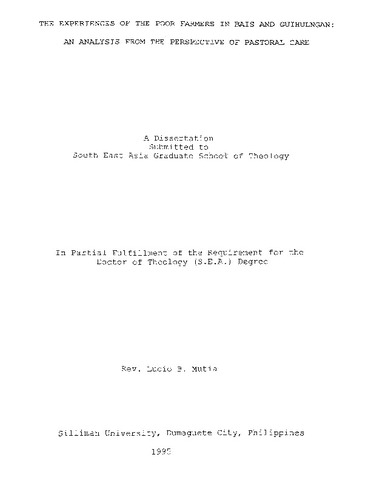
The experiences of the poor farmers in Bais and Guihulngan: An analysis utilizing the pastoral care perspective
Аннотации
This study investigates and analyzes the experiences of the poor farmers in Bais and Guihulngan, Negros Oriental, utilizing an analysis from the pastoral care perspective with emphasis on the following points:
1. The specific experiences of the poor farmers in church pastoral ministry and how these experiences impel them to initiate changes in their poverty stricken life. Specifically, the study focused on the precipitative factors and forces which were responsible for aggressively pushing farmers to opt for a better life.
2. The degree to which the experiences of helplessness and empowerment influence the poor farmers to adopt alternative solutions to their problems.
3. The concerns of the church ministry of the poor that best assists them to have a better life.
The research utilized the descriptive/evaluative method using pastoral and structural analysis approach. The subjects were farmers coming both from Bais and Guihulngan, Negros Oriental.
To facilitate the data for the study, personal interviews, questionnaires were administered. The analysis and evaluation of the data made use of the average mean and percentage distribution.
The investigation revealed that the experiences of the poor farmers with regards to the church pastoral ministry fall within the activities of Basic Christian Communities which includes health missions, organizing, food production and distribution of medicines.
The respondents are most familiar with the Community-Based Health Programs (CBHP) of the church followed by the Basic Christian Communities (BCC), of which the primary activities are sharing of faith, sharing of witness, and sharing of service.
It is significant that 61 percent of the respondents registered all these experiences within the ambit of the Church activities. Yet, these experiences were not decisive factors towards pushing for an aggressive option for a better life. The significant factors that served as the precipitators of radical change for better life were the experiences of hardships, pain and suffering. The investigation revealed that the church is not one of the leading institutions that work for the welfare of the poor farmers. She did not have a forceful nor tenacious influence to journey with the anawim of the Lord.
Instead, the clinical experiences of a crisis-laden daily life serve as the hard "living human documents” from which farmers learned. These experienced realities propelled farmers to resolutely validate their humanness. They exposed the basic causes of their suffering and proclaimed them to the world of the unpoor through marches and rallies.
With regards to the second point, the sense of defenselessness and helplessness was virtually evident among the poor farmers. Even when the poor farmers were harassed by the military and suspected as subversives, even when their houses were burnt down, their villages hamletted, even when some of them were tortured, the farmers of Bais and Guihulngan still hoped for a brighter future. Their sense of helplessness motivated them to unite and form a farmers’ organization--the very instrument that could empower and give them hope as they walked “through the valley of the shadow of death." They are opting for a change from within the root of the system - a radical transfiguration through the peaceful means, in the parliament of the streets.
With regards to the last point of the investigation, it was found out that the Church was not the primary initiator in pushing for a radical change in the farmers’ lives. Although through praxis, the farmers' movement for radical change was guided by the ethics of love and peace based on justice. This was seen in their militant yet peaceful campaigns.
In oder to serve as a formidable force for change the Church should have an alternative model of pastoral care. Fundamentally, it must reckon with the historical and biblical model of pastoral care-giving which is both individual and structural; in other words, wholistic. A model which is concretely responsive to and can fulfill the humanization needs of the poor farmers from pain and suffering. It must be a liberating pastoral care that promotes consciousness of the human person as the image of God. It has to have a commitment of educating people to metamorphose, claim and affirm the poor farmers’ rightful place in this world created by a just and living God.
The following basic criteria are important to have a progressive pastoral care in Church, as well in Church-related institutions:
a) Development of the personal, pastoral and professional competence of ministers in order that they maybe more aware of exactly how social conditions and structures affect the lives of others and of oneself.
b) Prepare Church people to participate in proclaiming the reality of divine liberation by understanding and “reading the Bible with Third World Eyes”. This requires a new understanding of Sunday school, auxiliaries, and all areas of the teaching ministry of the church.
c) Christian education that focuses on understanding God through Jesus Christ who is the liberator, redeemer, or savior. This means that the theme of liberation/salvation must permeate the entire church curriculum. Apart from liberation, there is no gospel.
d) Forcefully re-directing, claiming and affirming (keeping the poor farmers in mind) that the origin of pastoral care exists in theophany rather than in technology. Its conception exists in theology rather than in behavioral sciences.
e) Emphasize the utmost respect for the "wholeness" and “holiness” of human persons, including the integrity of creation, that humankind was created “in wholeness with the creation of God."
f) Underscore the individuals' eminence over all things, and not material things over the individual. A sense of importance is a powerful force that an individual may use to confront today’s realities as well as that of the future.
g) Balance the concern for individuals and structures (spiritual, economic, and political). This can serve as a good check against going to the extremes. This means an education that can analyze the present struggle of living in the light of what people envision the future to be.
Finally, the Church is challenged to be faithful to the living God who decisively sided with the deprived, the poor and the oppressed, the God who cared for individuals as well as societies.
Описание
Abstract only
Suggested Citation
Mutia, L. B. (1999). The experience of the poor farmers in Bais and Guihulngan: An analysis utilizing the pastoral care perspective [Unpublished doctoral dissertation]. South East Asia Graduate School of Theology.
Type
DissertationТематика

Keywords

Department
South East Asia Graduate School of TheologyDegree
Doctor of TheologyShelf Location
BT 212 .M88 1998
Physical Description
xviii, 233 leaves
Collections
- Doctor of Theology [11]