

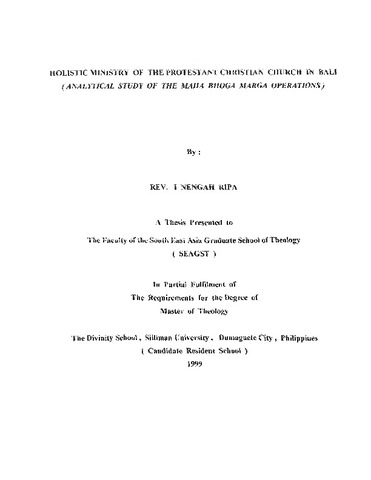
Holistic ministry of the protestant Christian church in Bali: (Analytical study of the Maha Bhoga Marga operations)
요약
This is an analytical study of the Protestant Christian Church in Bali, particularly the Maha Bhoga Marga (MBM) operations. The approach is one of Pastoral Theology using the three steps or stages: first, attending - seeking the information on the pastoral concerns that are available in personal experiences, Christian tradition, and cultural resources; second, assertion - engaging the information from these three resources in a process of mutual clarification and dialogue in order to expand and develop religious insight; third, decision - moving from insight through decision to concrete-pastoral action. The aim of this thesis is to evaluate the ministry of the Bali Church administered by the Maha Bhoga Marga Foundation and to give an answer to the question regarding urgent ministries that are needed in Bali. This question was asked by the delegation of the Bali Church Synod meeting in June 1998. These two aims are interconnected in this thesis as we reviewed the past and looked to the future.
The Protestant Christian Church in Bali or Gereja Kristen Protestant di Bali (GKPB, in Indonesian) was born as a "fundamentalist child under North American evangelical Christianity, specifically the “Christian Missionary Alliance" (CMA). Permission was granted from the Governor General of the Dutch Government to work among the Chinese immigrants in Bali. During that time there was strict prohibition to the evangelization of the Balinese people. By the power of the Holy Spirit the CMA missionary, Tsang To Hang, accompanied by Rev. R. A. Jaffry, baptized eleven Balinese Christians on November 11, 1931. The ministry of the Church focused on the spiritual meaning of the gospel, its mission was the “saving and gathering of souls." The Church denounced ancestor worship, the spirits, the temples and the idols. They were considered demonic. This action created conflict between Christians and non-Christians. As a result the Christians were persecuted, missionaries were rejected and finally expelled by the Dutch Government in 1933. The Balinese Christians became a flock without a shepherd.
From 1934 - 1948, the Dutch Reformed Church in East Java took care of the new Christians. Their ministry was in Pastoral Care, mainly directed toward pastoral counselling, Bible study, and care of the sick and dying. The new Christians were baptized in East Java. In 1948, the Bali Church decided to be independent of the pastoral care of the Dutch Reformed Church in East Java. The Protestant Christian Church in Bali was officially established and registered in the Indonesian Government on August 8, 1949. The ministry included Spiritual programs, Education programs, and Diakonia.
The decisive moment came with the “Watershed Synod Meeting of 1972" when the Bali Church decided on a “Holistic Ministry"-- to seek a balanced ministry both in spiritual and material aspects. Since then the Bali Church was no longer concerned only with the person's soul but also with the physical and economic life of the Balinese people. This holistic approach to ministry affirms that the human being has three basic needs: spiritual, mental, and physical.
The Bali Church administers this ministry by (1): Fellowship and Lay Training (Koinonia) related to the Dhyana Pura Foundation; (2) Witness and Education (Marturia) related to the Widhya Pura Foundation; (3) and Service and Economic Development (Diakonia), related to the Maha Bhoga Marga Foundation. The Maha Bhoga Marga (MBM) means the “most excellent way to physical and spiritual food, based on a right relationship with God and others”. The MBM was established in 1980 with a very clear theological foundation: 1. a belief in the dignity and high potential of all people created in the image of God; 2. a belief in God's mission of peace between people and God, people and people, people and earth’s resources through Jesus Christ the Lord; 3. a belief that models of God’s kingdom play a prophetic role in relationship to the government. The MBM's goal was to facilitate development of the poor and to promote the love of Christ by word and deed in a way which is consistent with the nature and mission of the Church.
To follow-up the “Watershed Synod Meeting of 1972”, the church leaders developed a plan to implement a holistic mission program in the Bali Church called “Long Range Planning Until the Year 2000". Among the goals were to make the Bali Church self-reliant in theology; in finances, and in human resources in order to bе a blessing to the nation. The program proposal included a timeline approved at the synod meeting of 1984 which makes the 1996 - 2000 as a period of harvest and evaluation to review the programs and the goals. The result of this evaluation will provide useful information for the future mission of the Church. This study is part of that review and evaluation.
The MBM has achieved the goals formulated by the Bali Church in 1972, 1980 and 1984. In fact, by 1982 the Bali Church as well as the MBM became self-reliant in staffing their programs. In 1994, the Bali Church became self-reliant in paying the salaries of the pastors. Also, since 1980, some congregations were able to remodel their church buildings using a Balinese architect. Beyond all of this, it is important to note that the Hindu population appreciates the services of the MBM.
This study is designed as follows: Chapter one is the general introduction: the statement of the problem, the goals of the study, scope and delimitation, method of the study and design. Chapter two provides an overview of the geography, culture and religion of Bali, the context within which the Bali Church and the MBM ministers. Chapter three evaluates the goals and the operation of the Maha Bhoga Marga, giving particular attention to its programs of Community and Economic Development and the important role of its Rural Bank Limited. Chapter four studies the relationship of the Maha Bhoga Marga to the missional understanding of the Bali Church. Chapter five examines the Biblical and theological basis of holistic mission, which gave birth to and sustains the MBM operations. Chapter six provides a brief summary and program recommendations for the MBM operation to address new situations both present and future.
기술
Abstract only
추천 인용
Ripa, N. I. (1999). Holistic ministry of the protestant Christian church in Bali: Analytical study of the Maha Bhoga Marga operations [Unpublished master's thesis]. South East Asia Graduate School of Theology.
유형
Thesis주제

학과
South East Asia Graduate School of Theology정도
Master of Theology선반 위치
BT 212 .R57 1999
물리적 설명
xi, 109 leaves
Collections
- Master of Theology [66]