

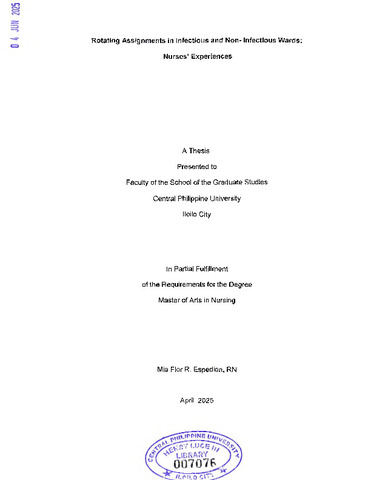
Rotating assignments in infectious and non-infectious wards: Nurses' experiences
요약
In nursing, rotating assignments involves the rotation of the nursing staff from one department to another to aid in increasing their capacity to care. (Charampolis et al., 2021).
However, rotating assignments were associated with lower quality of life and poorer health outcomes among nurses (Huang et al., 2015). One study found out that nurses who have experienced job rotation showed negative attitude towards it, have low levels of organizational commitment and high level of work related stress (Lee et al, 2012). It can also impact the quality of patient care, as nurses may be less familiar with the processes in their new assignment and they may be resistant towards it (Anjali,2023). Together with the negative impacts of rotating assignments, it may compromise the health and well-being of nurses.
In this descriptive qualitative study, the experiences of nurses with rotating assignments from the infectious to noninfectious wards were described. The six (6) participants share three (3) themes which are the following: (1) challenges in rotating assignments, (2) learning to adapt and (3) skill development. The three themes highlighted the complexities of rotating assignments during a pandemic. Each subject is further emphasized by evidence that underlines the necessity of IPC compliance, discusses the problems encountered, examines adaption options, and emphasizes the value of professional development. These findings illustrate nurses' perseverance and devotion in tackling enormous obstacles.
기술
Abstract only
추천 인용
Espedion, M. F. R. (2025). Rotating assignments in infectious and non-infectious wards: Nurses' experiences [Unpublished master's thesis]. Central Philippine University.
유형
Thesis주제

학과
School of Graduate Studies정도
Master of Arts in Nursing선반 위치
Filipiniana Theses 610.73072 Es64
선반 위치
RT 71 .E87 2025
물리적 설명
xi, 85 leaves