

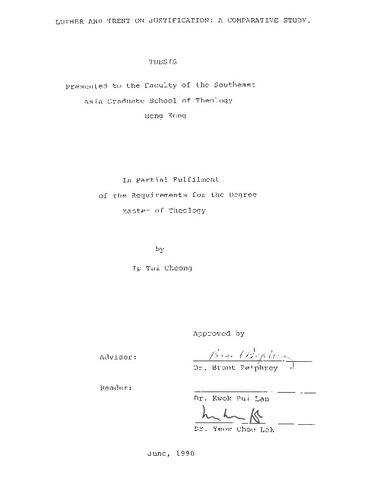
Luther and Trent on justification: A comparative study
Page views
149Petsa
1990Magbahagi
Metadata
Ipakita ang buong tala ng itemAbstract
In this paper I will present a comparative study of Martin Luther's teaching regarding the doctrine of justification and the presentation of this doctrine in the documents of the Council of Trent (1545). against the background of Scholastic tradition. In the course of the presentation I will discuss the views of various medieval theologians, including Augustine. Anselm, Thomas Aquinas and the Via Moderna. As a result, the different shapes given to the doctrine of justification (the way of the presentation, as well as the contents) will be seen contextually and not in the isolation in which they are so often viewed.
My interest in this subject was first stimulated during my course of the study of Law and Gospel in Luther's Theological Writings. In the course of my study, it became clear to me that the failure to read the doctrinal statements about justification against their proper dogmatic and historical context leads to distortion. As this habit persists into our own times, it proves to be a great hindrance to useful and productive dialogue between contemporary adherents of the various traditions; in particular between Lutherans and Roman Catholics. It is my hope that increased appreciation of the contextual place of the doctrine of justification in the divergent traditions on both sides, might not only promote a renewal of dialogue, but give that effort the greater promise of productivity.
The purpose of this thesis is to provide the background material for the study of the identity of the Lutheran Church, especially for the Lutheran church, Hongkong Synod.
There is a need of the study of the identity of the Lutheran Church, because wo are living in a pluralistic denominational age: there is a tendency for any Lutheran Church to be integrated in the part of the ecumenical movement; although for the time being, our partner church, the Lutheran Church Missouri Synod is still not part of the WCC, nor the LWF. However, every Lutheran Church has to ask herself a question, what is the identity of being a Lutheran Church today? What are the differences between the Lutheran Church, and the Roman Catholic Church, after all.
There is another need of the study of the identity of the Lutheran Church, because even the Lutheran Church, Missouri Synod has to face the problem of dialogue, dialogue with other denominations. For any dialogue to be effective and meaningful, it involves self study, and we are not going to sacrifice our precious heritage just for the sake of consensus.
There is a further need for the study of the identity of the Lutheran Church, especially for the Lutheran Church, Hongkong Synod. By the time of 1997, Hongkong would become part of China; and Hongkong Church would become part of the Chinese Church, the Lutheran Church, Hongkong Synod has to ask herself, what contributions she can contribute to build up the national Church. I think the subject of "justification" can help, because this is the most crucial issue during the Reformation period.
For Augustine and Thomas Aquinas, as well as Anselm, justification was merely one dogmatic locus among many others. Strictly speaking, they do not have a doctrine of justification, they combine it with regeneration, predestination, sanctification, and so on. So Hans Kung, a contemporary Catholic theologian, can write: "For the Catholic, the theology of justification is not suspendedin mid-air but rather integrated into the all-encompassing mystery of the redemption of Jesus Christ and defined from this viewpoint" (Kung, P.123).
For traditional Catholicism the question of justification is an "as well as", for Luther he stressed the importance of the doctrine and uses a multitude of metaphors to explain it as "the proposition of primary importance" (Lectures on Genesis. 1535, LW 4:400) because "Christ wants us to concentrate our attention on this chief doctrine, our justification before God, in order that we may believe in Him" (Sermons on the Gospel of St. John, _. 1530 LW 23:109). It is "the cardinal doctrine of justification by faith in Christ" (Ibid, 207), and the "true and chief article of Christian doctrine" (Preface to the Acts of the Apostles, 1523. LW 35:363).
Along with Luther's very high regard for his doctrine of justification by faith was his awareness that his presentation marked a departure from the medieval scholastic theology, but he thought he was reinstituting the orthodox doctrine, as opposed to the doctrine of work and the mass. He knew that treating justification as a distinct doctrine constituting the center of belief and the norm for determining every type of doctrinal error was quite unknown to the theology of the Middle Ages, if only because Thomas Aquinas treated it in connection with the teaching about grace. I believe that current lack of awareness of the contextual place of justification in medieval thought (which persists in contemporary Roman Catholicism) presents a serious obstacle to dialogue. Similarly, those of the Lutheran tradition must increase their awareness of the radical change of context which was effected by Luther. Unless such a change is brought about, Lutheran-Roman Catholic dialogues will continue to "compare apples with oranges", and hold little prospect for progress in understanding, much less reconciliation.
I have divided the present study into three chapters. In chapter one I will present the Medieval Understanding of Justification, including Augustine, Anselm, Thomas Aquinas and the Via Moderna. which serves as background material against which both Luther and Trent must be understood. The second chapter concerns itself with the doctrine of Justification in Luther's writings and in the Tridentine Documents. Chapter Three entitled comparison and concludes the thesis.
I would like to thank Dr. Andrew Chiu. Dr. Brant Pelphrey and especially Dr. James Rimbach of Concordia Theological Seminary for their interest and assistance in the preparation of the thesis.
Paglalarawan
Preface
Mungkahing Sipi
Cheong, I. T. (1990). Luther and Trent on justification: A comparative study [Unpublished master's thesis]. South East Asia Graduate School of Theology.
Uri
ThesisMga Paksa

Kagawaran
South East Asia Graduate School of TheologyDegree
Master of TheologyLokasyon ng Istante
BT 212 .C44 1990
Pisikal na paglalarawan
93 leaves
Collections
- Master of Theology [75]