
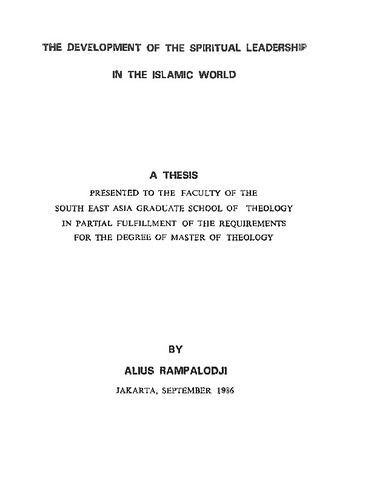
The development of the spiritual leadership in the Islamic world
Page views
166发表日期
1986股票
元數據
显示条目完整记录摘要
When Mohammed was still alive, he did not leave a message that could be used as a guide for choosing a man to replace him. This became one of the important reasons of the existence of the Shi'ites which then separated themselves from the Sunnah (the majority group of Islam). The Shi'ites thought that only Ali bin Abu Thalib (the nephew and son in - law of Mohammed) and his descendants had the right to be the leader of the moslems. This view which later became the formal teachings of the Shi'ites, existed because of the influence of the ancients tradition in South Arabians and many others. For example, Christianism, Gnosticism and all the inherited lore of ancient Syria and Babylonia. The ancient tradition of the South Arabians considered that the king was the incarnation of God, and the God could save the people by him. The Shi’ites thought that God himself had determined Ali bin Abu Thalib and his descendants to be the Moslems Leaders, because they had the traits that could not be found in any other persons, they had something special from God. The Shi’ites tended to call their leader " Imam ”, rather than caliph. Imam meant leader, and caliph, meant the successor ( khalifa ).
Iran received the Shi’t e s аs «s formal religion in the sixteenth century. This made the Ulama (singular 'Alim, Moslem “priest” ) get the special position in the society. In the Shi'ites concept, it was said that after the twelfth Imam disappeared and will return again at the end of the world, there was not any Imam, so the position was replaced by the Ulama who were acknowledged as the truth of the religious resources by the Iranians. In the conflict between the Ulama and the government, unconsciously, the influence of the Ulama was more dominant. Though government strictly controlled the religious activities, the relationship between the Ulama and their followers through the activities done in the mosques and traditional Islamic schools (Madrasah) was still existing. The struggle of the Ulama won the sympathy of the Iranians lower society who were unsatisfied with the government's authorities. It can be concluded that basically the main purpose of the Ulama was not to build the Islamic State but to overthrow the monarchy's power after they had seen the failures and the un faithfulness of the Monarchy in managing the Islamic government.
The Indonesian people were not the follower of the Shi'a. But whom the government constructed the constitution before the independence of the Republic of Indonesia, Moslem figures tried to mark Islam as the State Religion, and it was stated that the president of Indonesia must be Moslem, and the Ulama in an Islamic organisation, called Nahdatul Ulama ( NU ) who moved in the political world, did the utmost, so that Islam world be the basis of the state. But in 1985 Nahdatul Ulama ( NU ) became one of the religion organisations which was not involved in practical policy, they supported the government to continue the development of the Republic of Indonesia which was not based on a certain religion . Nahdatul Ulama ( NU ) is the biggest religion organisation and the Ulama are respectful in Indonesia.
The Iran revolution will not emerge in Indonesia as long as the Moslems are not discredited, and in the development of Indonesia, the government show high attention and respect towards religion without imitating the development in the west which considers that religion is a personal matter. So when there is a intention to make Islam as the basis of the state of the Republic of Indonesia, it is an individual or groups intention, not the intention of all the Moslems.
描述
Abstract only
建议引文
Rampalodji, A (1986). The development of the spiritual leadership in the Islamic world [Unpublished master's thesis]. South East Asia Graduate School of Theology.
文件类型
Thesis主题

部
South East Asia Graduate School of Theology学位
Master of Theology货架位置
BT 212 .R36 1986
物理描述
viii, 84 leaves
集合
- Master of Theology [75]
相關項目
顯示由標題,作者,創造者和主題相關的項目。
-
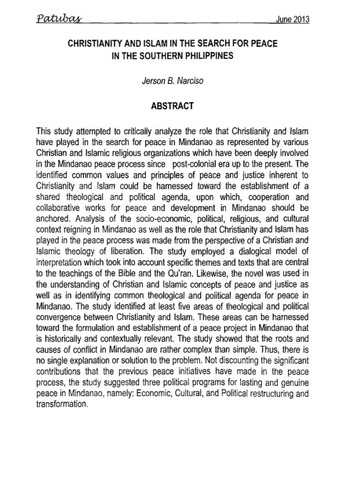
Christianity and Islam in the search for peace in the Southern Philippines
(Central Philippine University, 2013-06)This study attempted to critically analyze the role that Christianity and Islam have played in the search for peace in Mindanao as represented by various Christian and Islamic religious organizations which have been deeply ... -
The role of reason and revelation in Islam according to Jamal al-Din al-Afghani and Muhammad Abduh: An historical analysis
(South East Asia Graduate School of Theology, 1987-05)Islam is a religion both of revelation and of reason. Beginning from such a statement, I have chosen as the title for my thesis, "The role of reason and revelation in Islam”. But because this is a very big subject, I have ... -
The position of Dhimmis in Islam: An historical perspective
(South East Asia Graduate School of Theology, 1996-09)The title of the dissertation is The Position of Dhimmis in Islam: An historical perspective. The dhimmis or ahl al-dhimma are non-Muslims living as minorities in Islamic state protected by a dhimma, a pact. From Islamic ...