

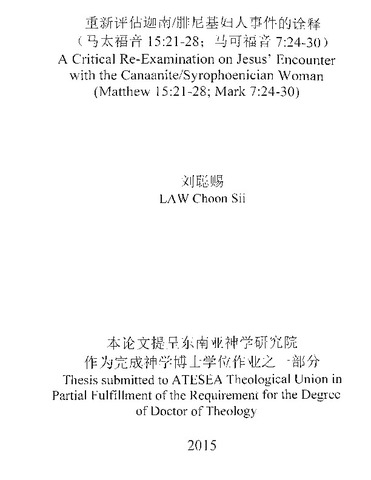
A critical re-examination on Jesus' encounter with the Canaanite/Syrophoenician woman (Matthew 15:21-28; Mark 7:24-30)
Page views
229Petsa
2015Magbahagi
Metadata
Ipakita ang buong tala ng itemAbstract
This thesis attempts to resolve a difficult incident in New Testament studies: Jesus' encounter with the Canaanite/Syrophoenician woman as recorded in Matthew 15:21 -28 and Mark 7:24-30. There are two difficult questions posed by this incident. The first question ("Why was Jesus unkind in rejecting the woman's request?") relates to why Jesus refused to heal her daughter initially: the second question (Why did Jesus change his mind subsequently?) revolves around the seemingly erratic response of Jesus in subsequently changing his mind by healing the daughter after hearing the appeal of the woman.
This thesis adopts the historical approach. Firstly, chapter 2 and chapter 3 comprise the literature review and our evaluation on these two difficult questions. In the process and as a result, we identify two major views, namely "salvation-history reading" and "feminist reading", need further exploration.
In chapter 4, we argue that Jesus was indeed faithful to what he said in Matthew 15:24: “() C,k dneaTci入rp' ei [in dq* t6 TTp(’)(3aTa t6 duo入⑴入(’)Ta oI’kod ’lapar^V’ (1 was sent only to the lost sheep of the house of Israel). We examine ten passages covering Jesus' ministry where those he reached out to have often been assumed to be Gentiles (Mark 3:7-12; Matthew 4:23-25/Luke 6:17-19; Matthew 8:28-34/Mark 5:1-20/Luke 8:26-30; Mark 7:31- 37: Matthew 15:29-31:, Matthew 15:32-39/Mark 8:1-10: Mark 8:22-26; Matthew 17:14- 21/Mark 9:14-29/Luke 9:37-43a; John 4:46-54 and Matthew 8:5-13/Luke 7:1-10). And we come to a conclusion that Jesus was indeed faithful to his messianic mission to the house of Israel. In other words, the ethnicity of the woman's daughter was not the reason of Jesus' unkindness, and Jesus did not change his mind as a result of the woman's reply, and thus crossing over the ethnic boundary. Jesus remained faithful to salvation-history and that his ministry was to the Jews. As such, Jesus rejected the initial request of the woman to heal her daughter.
In chapter 5, we argue that Jesus remained faithful to his messianic mission to the house of Israel. Which does not exclude women. For all his healing ministry, he had never rejected any request from a woman (Matthew 8:14-15/Mark 1:29-31/Luke 4:38-39; Matthew 9:18-19. 23-26/Mark 5:21-24a. 35-43/Luke 8:40-42. 49-56; Matthew 9:20- 22/Mark 5:24b-34/Luke 8:42b-48; Luke 7:11-17; Luke 13:10-17: and John 11:1-44). In fact. Jesus reached out to whoever that had needs. In other words, gender issue was not the reason of Jesus unkindness. Jesus did not change his mind as a result of the woman's reply and subsequently crossing over the gender boundary.
In chapter 6 and chapter 7, we focus our study on these two passages with these two fundamental questions respectively. For the first question ("Why was Jesus unkind in rejecting the woman's request”), we argue that Jesus did not respond to the woman's request initially because he remained faithful to the messianic mission and the order of salvation-history, that is, salvation is to the Jews first.
For the second question (Why did Jesus change his mind subsequently?), we argue that while Jesus remained faithful to his messianic mission, the woman seized the opportunity to pursue her request the comment by Jesus to the woman as a parable: is not fair to take the children's food and throw it to the dogs (Matthew 15:26)" Let the children be fed first, for it is not fair to take the children's food and throw it to the dogs "(Mark 7:27). Intended to be an imitation that the "dogs" can enter into the house of Israel. The woman replied brilliantly by saying that "even the dogs eat the crumbs that fall from their masters' table" (Matthew 15:27) “even the dogs under the table eat the children's crumbs" (Mark 7:28). In other words, the woman insisted that the dogs were willing to enter into the house and so became the dogs of the masters, and thus they could legitimately eat the crumbs that the children dropped from the table. Therefore, Jesus subsequently changed his mind in healing the woman's daughter is due to her positive response to the invitation issued by Jesus in the parable.
Chapter 8 is the conclusion. The reason for "Why was Jesus unkind in rejecting the woman's request?" is due to his faithfulness to his messianic mission only to the house of Israel. As to the reason. "Why did Jesus change his mind subsequently?" it is because the woman was willing to enter into the house of Israel, and so the healing can be extended to her daughter. In the whole process of the incident, Jesus remained faithful to his messianic mission.
Lastly, in chapter 9, we study and evaluate some Asian contextual interpretations of this account. While we appreciate the concerns of these Asian scholars for the contexts and the plights of many, this account is not appropriate as a direct response to those current issues raised. However, we can still draw some lessons for the Malaysian churches today.
In sum, according to the incident of Jesus' encounter with the Canaanite/Syrophoenician woman, this thesis argues that Jesus remained faithful to his messianic mission to the Jews according to salvation-history.
Paglalarawan
Abstract only
Mungkahing Sipi
Law, C. S. (2015). A critical re-examination on Jesus' encounter with the Canaanite/Syrophoenician woman (Matthew 15:21-28; Mark 7:24-30) [Unpublished doctoral dissertation]. Association for Theological Education in Southeast Asia.
Uri
DissertationMga Paksa

Mga keyword
Kagawaran
Association for Theological Education is Southeast AsiaDegree
Doctor of TheologyLokasyon ng Istante
BT 212 .S55 2015
Pisikal na paglalarawan
242 leaves
Collections
- Doctor of Theology [11]