

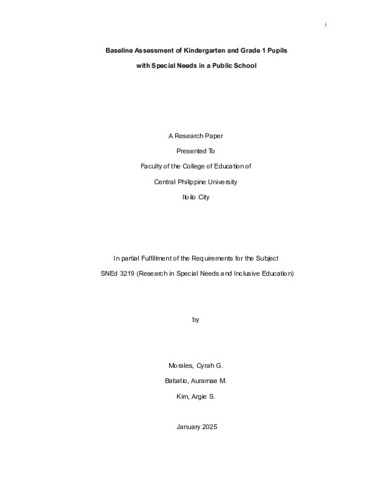
Baseline assessment of kindergarten and grade 1 pupils with special needs in public school
| dc.contributor.adviser | Durban, Joel M. | |
| dc.contributor.author | Morales, Cyrah G. | |
| dc.contributor.author | Babatio, Auramae M. | |
| dc.contributor.author | Kim, Argie S. | |
| dc.date.accessioned | 2025-11-19T01:17:14Z | |
| dc.date.available | 2025-11-19T01:17:14Z | |
| dc.date.issued | 2025-01 | |
| dc.identifier.citation | Morales, C. G., Babatio, A. M., & Kim, A. S. (2025). Baseline assessment of kindergarten and grade 1 pupils with special needs in public school [Unpublished bachelor's special paper]. Central Philippine University. | en_US |
| dc.identifier.uri | https://hdl.handle.net/20.500.12852/3582 | |
| dc.description | Full text available | en_US |
| dc.description.abstract | This research assessed kindergarten and grade 1 pupils in a public school to identify learning problems in math, reading, and writing. Employing a quantitative survey design (Creswell & Creswell, 2023), the study used a two-stage identification process. Stage one involved universal screening with the Early Childhood Care and Development (ECCD) checklist for developmental delays and Hannel's (2006) checklist for learning difficulties and conduct disorders. While no conduct disorders or developmental disabilities were identified, several students were flagged for potential learning difficulties. Stage two comprised individual educational assessments in math, reading, and writing for these students. Participants were referred kindergarten and grade 1 students (2023- 2024) whose parents provided consent and who themselves assented. Instruments included the ECCD checklist, assessing developmental milestones across multiple domains, and Hannel's checklist, aiding in identifying learning problems and referral for special education assessment. Data collection involved school permission, coordination with staff, and individual assessments with a one-researcher-to-one-pupil ratio. Teacher interviews supplemented data. Analysis used descriptive statistics to identify areas of concern. Results indicated significant learning challenges across all participants. All struggled with reading (decoding, letter recognition, fluency, comprehension), writing (spelling, sentence construction), and math (numeracy, arithmetic fluency, number sense, formulas). The study concludes that these students require targeted interventions and instructional strategies. Parent-educator collaboration is crucial. Early interventions are essential for developing foundational skills for academic success. This research emphasizes the critical role of early literacy and numeracy development. | en_US |
| dc.format.extent | x, 105 leaves | en_US |
| dc.language.iso | en_US | en_US |
| dc.publisher | Central Philippine University | en_US |
| dc.rights.uri | http://publicdomain.org/publicdomain/zero/1.0/ | * |
| dc.subject.lcc | LB 2326.3 .M67 2025 | en_US |
| dc.subject.lcsh | Special education--Evaluation | en_US |
| dc.subject.lcsh | Educational tests and measurements | en_US |
| dc.subject.lcsh | Kindergarten--Evaluation | en_US |
| dc.subject.lcsh | First grade (Education)--Evaluation | en_US |
| dc.subject.lcsh | Children with disabilities--Education (Elementary) | en_US |
| dc.title | Baseline assessment of kindergarten and grade 1 pupils with special needs in public school | en_US |
| dc.type | Special paper | en_US |
| dcterms.accessRights | Publicly accessible | en_US |
| dc.description.bibliographicalreferences | Includes bibliographical references | en_US |
| dc.contributor.chair | Junsay, Merle | |
| dc.contributor.committeemember | Gomez, Eden P. | |
| dc.contributor.committeemember | Tayo, Melly Beth L. | |
| dc.contributor.department | College of Education | en_US |
| dc.description.degree | Bachelor of Special Needs Education | en_US |
Files in this item
This item appears in the following Collection(s)
-
Special papers [12]