

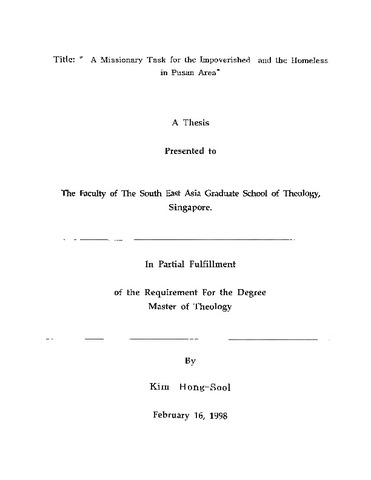
A missionary task for the impoverished and the homeless in Pusan area
| dc.contributor.adviser | Lee, Nam-Sup | |
| dc.contributor.author | Kim, Hong-Sool | |
| dc.date.accessioned | 2025-10-04T01:46:27Z | |
| dc.date.available | 2025-10-04T01:46:27Z | |
| dc.date.issued | 1998-02-16 | |
| dc.identifier.citation | Kim, H. S. (1998). A missionary task for the impoverished and the homeless in Pusan area [Unpublished master's thesis]. South East Asia Graduate School of Theology. | en_US |
| dc.identifier.uri | https://hdl.handle.net/20.500.12852/3552 | |
| dc.description | Abstract only | en_US |
| dc.description.abstract | The rate of urban population in the world has increased from 29% (1950) to 45% (1990). It is now expected that about 65% of the world population will center around urban area in 2025. In particular, the urbanization in the third world countries including Korea has been prompted by industrial policies, devastating rural villages and producing an increasing number of poor urban dwellers. This group of poor urban dwellers has been denigrated as social outcasts as they were deprived of their economic ground and social stability in the midst of the current colonizing capitalism and unequal social hierarchy. Consequently, they suffered from unemployment, alcohol addiction, impoverishment, and family dissolution. The national policies for them, however, do not go beyond the superficial level on which they are recognized as the chief target to be watched over. The social outcasts are produced by the disintegration of one's personal life and family life, as well as by unfair social structure. Since they are dropped off from the center of our society, they are to be protected on the national level. But no legal protection is granted for the sake of those people. Only arbitrary governmental order is all in practice. This system is like a husk without kernel. Once the issues on human right have been raised for them, the government has sought to protect them passively without being able to restore their humanity and social relationship. To make it worse, many of them are guarded in ill- conditioned mental health care centers and rehabilitation centers, yet their rehabilitation programs turn out unproductive. In this midst, there came to be an increasing number of voluntary groups to manage rehabilitation programs with a view to caring for the alienated social outcasts in a community life, in order that they restore their family role and social role. The 'House of Resurrection' which I managed for the past four years with eight years of program coordination is one of the examples in this regard. Out of my experiences, I could realize anew the theological significance and missionary task of social welfare in response to their need. I am now confident that the diakonia mission for the social outcasts and the poor is the major part of the mission in the Korean church in face of the 21st century. The practical alternative plan proposed in this thesis is to nourish their faith, to improve their human right, and to prompt their rehabilitation. The gospel for the poor is now more urgent as a hope for healthy social welfare since the whole globe has been turning into a big market with limitless competition. | en_US |
| dc.format.extent | 63 leaves | en_US |
| dc.language.iso | other | en_US |
| dc.publisher | South East Asia Graduate School of Theology | en_US |
| dc.subject.lcc | BT 212 .K56 1998 | en_US |
| dc.subject.lcsh | Church work with the homeless | en_US |
| dc.subject.lcsh | Church work with the poor | en_US |
| dc.subject.lcsh | Evangelistic work | en_US |
| dc.title | A missionary task for the impoverished and the homeless in Pusan area | en_US |
| dc.type | Thesis | en_US |
| dcterms.accessRights | Limited public access | en_US |
| dc.description.bibliographicalreferences | Includes bibliographical references | en_US |
| dc.contributor.department | South East Asia Graduate School of Theology | en_US |
| dc.description.degree | Master of Theology | en_US |
| local.subject | Missionary task | en_US |
이 항목의 파일
This item appears in the following Collection(s)
-
Master of Theology [69]