
Ipakita ang simpleng tala ng item
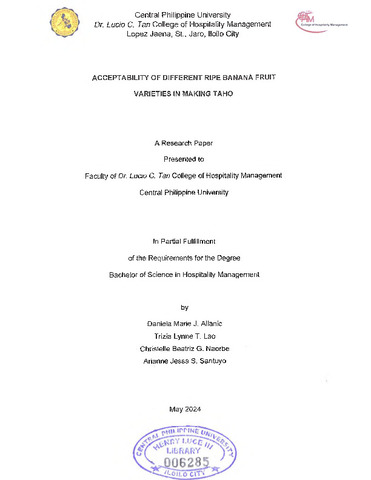
Acceptability of different ripe banana fruit varieties in making taho
| dc.contributor.author | Allanic, Daniela Marie J. | |
| dc.contributor.author | Lao, Trizia Lynne T. | |
| dc.contributor.author | Naorbe, Christelle Beatriz G. | |
| dc.contributor.author | Santuyo, Arianne Jessa S. | |
| dc.date.accessioned | 2025-10-03T01:35:42Z | |
| dc.date.available | 2025-10-03T01:35:42Z | |
| dc.date.issued | 2024-05 | |
| dc.identifier.citation | Allanic, D. M. J., Lao, T. L. T., Naorbe, C. B. G., & Santuyo, A. J. S. (2024). Acceptability of different ripe banana fruit varieties in making taho [Unpublished bachelor's special paper]. Central Philippine University. | en_US |
| dc.identifier.uri | https://hdl.handle.net/20.500.12852/3547 | |
| dc.description | Abstract only | en_US |
| dc.description.abstract | This study aimed to evaluate the acceptability of different ripe banana fruit varieties in making taho, a traditional Filipino delicacy. The study aimed to assess the levels of acceptability of Lakatan (Musa acuminata Colla), Latundan (Musa acuminata x M. balbisiana), Saba (Musa acuminata x balbisiana), and Sehorita (Musa acuminata 'Señorita') in terms of aroma, taste, appearance, texture, and overall acceptability. A quantitative research design was employed, utilizing a validated researcher-made questionnaire to collect data from at least 50 respondents of a private higher education institution in Iloilo City, Philippines. Statistical analysis, including ANOVA and Pearson correlation coefficient, was employed to analyze the data. Results revealed that Lakatan banana taho stood out in taste and texture and was highly acceptable. The findings were consistent across various demographic groups, indicating universal appeal. Latundan and Saba banana taho showed slightly lower ratings, while Señorita banana taho displayed a selective appeal based on sensory preferences. Moreover, the research explored the significant differences in the acceptability of Lakatan banana taho compared to the original taho. The results indicated high acceptability levels for Lakatan banana taho in aroma, appearance, taste, and texture across all demographic categories, with no significant variations in preferences. Notably, the study found a moderate positive correlation between the preferred Lakatan banana taho and the original taho, suggesting consistent preference among respondents. In conclusion, the research identified Lakatan banana taho as a preferred choice with high acceptability, showcasing its potential as an alternative to traditional taho. | en_US |
| dc.format.extent | ix,158 leaves | en_US |
| dc.language.iso | en_US | en_US |
| dc.publisher | Central Philippine University | en_US |
| dc.rights.uri | http://publicdomain.org/publicdomain/zero/1.0/ | * |
| dc.subject.lcc | TX 911 .A45 2024 | en_US |
| dc.subject.lcsh | Bananas | en_US |
| dc.subject.lcsh | Cooking (Bananas) | en_US |
| dc.subject.lcsh | Bananas--Varieties | en_US |
| dc.subject.lcsh | Bananas--Processing | en_US |
| dc.subject.lcsh | Food preferences--Research | en_US |
| dc.subject.lcsh | Food--Sensory evaluation | en_US |
| dc.subject.lcsh | Street food | en_US |
| dc.subject.lcsh | Food industry and trade | en_US |
| dc.title | Acceptability of different ripe banana fruit varieties in making taho | en_US |
| dc.type | Special paper | en_US |
| dcterms.accessRights | Not publicly accessible | en_US |
| dc.description.bibliographicalreferences | Includes bibliographical references | en_US |
| dc.contributor.chair | Bayot, Maria Patricia | |
| dc.contributor.committeemember | Gonzales, Jocelyn G. | |
| dc.contributor.committeemember | Melliza, Ma. Rhea Rizza | |
| dc.contributor.committeemember | Luceño, Myrna T. | |
| dc.contributor.department | College of Hospitality Management | en_US |
| dc.description.degree | Bachelor of Science in Hospitality Management | en_US |
Mga file sa item na ito
Lumilitaw ang item na ito sa mga sumusunod na (mga) Koleksyon
Mga parehong item
Ipinapakita ang mga item na nauugnay sa pamagat, may-akda, tagalikha at paksa.
-
Mycelial growth of Philippine edible straw mushroom (Volvariella volvacea) grown in banana leaf culture medium added with different levels of table sugar
(2020)This study was conducted from January 30 to February 6, 2020 at the Western Visayas Integrated Agricultural Research Center (WESVIARC), Jaro, Iloilo City. This study aimed to determine the mycelial growth of Philippine ... -
Efficacy of lemongrass (Cymbopogon citratus DC. Stapf) extract against banana corm weevil (Cosmopolites sordidus Germar)
(2019)This study was conducted at the College of Agriculture, Resources, and Environmental Sciences laboratory room, Central Philippine University, Jaro, Iloilo City from August 13 to 18, 2019. This study aimed to determine the ... -
Growth performance of Lacatan banana (Musa sapientum L.) fertilized with different brands of commercial organic fertilizer at Ilong Bukid, San Rafael, Iloilo conditions: A community based participatory research
(Central Philippine University, 2010-10)The study was conducted from February 26 to June 29, 2007 at Ilong Bukid, San Rafael, Iloilo. It determined the efficiency of the different brands of organic fertilizer on the growth of Lacatan banana and obtained baseline ...