

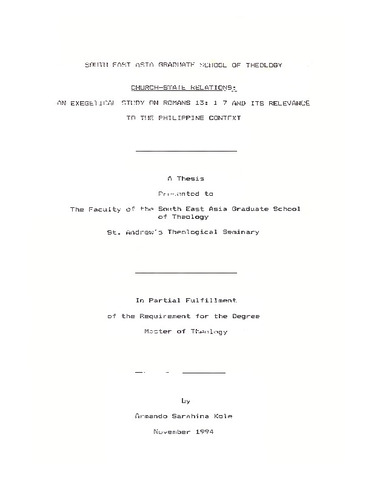
Church-state relations: An exegetical study on Romans 13:1-7 and its relevance to the Philippine context
Аннотации
This thesis deals with the topic, "Church-State Relations: An Exegetical Study on Romans 13: 1-7 and Its Relevance to the Philippine Context". It is a subject which many Christians consider as "controversial" in the light of the modern concept of the state especially among the liberal democratic countries of the world. Many have asked the questions, "Is Paul's instruction to submit to the governing authorities in Romans 13:1 still applicable today?" “And to what extent should a Christian obey the civil authorities?"
The aim of the first major section of the thesis is to find out the meaning of the text in Romans 13: 1-7 from the original Greek language by applying the exegetical principles. It consists of three chapters: (1) The Diving Sanction of the State (vv. 1-3); (2) The Nature of the State as principles Servant. (vv. 4-5); and (3) The Responsibilities of the Christians toward the State (vv. 6-7).
The second major section deals with the relevance of Romans 13:1-7 to the Philippine context. Here, attempts are made to explain and to clarify certain misinterpretations of Christians regarding the relationship that exists between the church and the state. Two of these misinterpretations are discussed in this section, namely: (1) Misinterpretation related to the meaning of submission to the states. The writer notes that the original Greek text for exousia (authority) does not warrant the civil authorities to do anything that pleases them, neither does it give them a blanket authority to exercise their power at any cost. In other words, their authority, no matter how vast and comprehensive it may be, is still a subordinated authority. Hence, it follows that Christian submission is a qualified submission; (2) Misinterpretation related to the principle separation of Church and State. Most often Christians understand this phrase to mean total non-interference between the church and state. To others it presupposes the avoidance of political discussions in the church. Because of this many have come to believe that a church should not entertain nor criticize the policies and actions of the state no matter what they may be. This is one example of a church that is politically acquiescent.
The third major section discusses the conflict, between the church and state in the Philippines during the regime of the late President Marcos which culminated at the 1986 EDSA Revolution. The writer highlights in the chapter not only the extent of oppression of the Filipinos, the abuse of authority of the dictatorship, the disregard for virtue and morality implied in Romans 13: 4, 6, & 7, but also his understanding of the role of the church in times of social upheaval. In his opinion, the conglomerate response of the churches against the Marcos dictatorship through People Power at EDSA on February 22-25, 1986 was the result of their reflection and understanding of the theology and power of the church not just as the of truth and righteousness, and sentinel of social morality in society, but also as a counter-community posed to fight against the abuses of the state in a non-violent way.
The last section includes the summary, conclusions and recommendations of the writer. In his view, the context of Romans: 13:1-7 cannot be taken as it is and then be applied to any situation regardless of the political cultures of the people. In other words, one should not treat the text as a scriptural injunction to justify any state action. This catchword on civil obedience must be questioned by the Christians. If God alone possesses a comprehensive, encompassing and absolute authority, then any act or promulgation of the state which runs counter with the laws of God must be resisted regardless of the consequences.
Описание
Abstract only
Suggested Citation
Kole, A. S. (1994). Church-state relations: An exegetical study on Romans 13:1-7 and its relevance to the Philippine context [Unpublished master's thesis]. South East Asia Graduate School of Theology.
Type
ThesisТематика

Keywords
Department
South East Asia Graduate School of TheologyDegree
Master of TheologyShelf Location
BT 212 .K65 1994
Physical Description
ix, 95 leaves
Collections
- Master of Theology [75]