

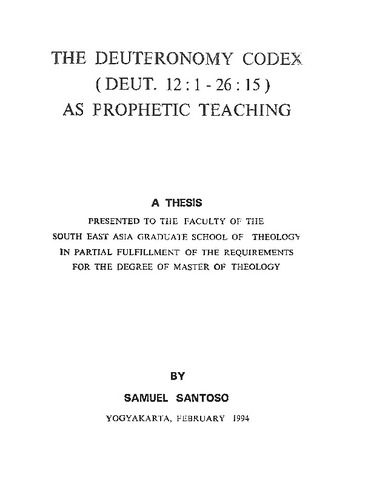
The Deuteronomy Codex (Deut. 12:1-26:15) as prophetic teaching
摘要
Discussion about many sides of Deuteronomy is still going on since de Wette published his opinion that Deuteronomy reflected the situation of Josia's Religious Reformation on 621 BC. He said that the book read by Josia at the moment of his reformation was a collection of law book called in technical term Ur-deuteronomium, Deuteronomy in its original form. Many questions arouse then. Who were the writer of the book? When was the book compiled and in what sort of situation? What is the original meaning of the book? These questions show that Deuteronomy has enough complexity to discuss.
Many similarities between D's structure w with the Vassal Treaty of Essarhaddon from about 13 century BC discovered by Mendenhall helps one to find its deeper meaning. From the structure itself it is noted that chapters 12-26, usually called as Deuteronomic Code, are received as the core of Deuteronomy. Naming these chapters the code of the law give to the reader indication that content of it were stricking regulations, laws and legal about religious and moral matters. But when we read the book we find not only religious legal formula but, more precisely, the preaching and teaching about religious and moral laws. Compared with the legal matters of other sources of Pentateuch, J-E-P, D's teaching stressed on the ethical dan moral rather than doctrinal matters. The content of the teaching itself has many similarities with the preaching and teaching of the pre exilic prophets from VIII-VII century BC. in both North Israel and Judaea. This arouses assumption that there are relations between D and the pre exilic prophets in Israel to face the same situation about religious and ethical living of the nation.
This thesis aims to find some meaning of D's code today for the ethical norms as contribution of the OT ethnic to the Christian Ethic to the Indonesia's situation which is influenced by Islamic moral conducts. This is explained in the first chapter of this writing.
The second chapter content is the explanation about the matters of Introduction to the book of Deuteronomy, about the dating and the structure of the book. The book looks as a series of Moses’ farewell preaching to the Israel who is coming to the promised land in Cis Jordan and Deuteronomy as the covenantal treaty between Yahwe and His people and D as the book of the Law. Especially as the covenantal treaty D confirm that the faithfulness of all nation to the tora' confirm the salvation Yahwe gave to them.
The third chapter explained the relation between prophetic movement on the VIII-VII century BC and their specific characteristic and their relevance to the religious, moral and political situation of the nation.
The fourth chapter content of the exegesis of Deuteronomy 12-26 as core of the book of Deuteronomy. This Deuteronomic Code exposed two major themes eq. the command to guard the purity of people's worship to Yahwe. Centralization of worship in one place only and the abomination all things relations with worship to the alien's gods. In this thing the people of God must have an exclusive attitude. But in the other hand the operation of the components of worship itself must be inclusive. The land and its prosperity is God’s so His people must be doing the same. The prosperity not only for some peoples only but for all. For this purpose Deuteronomy stressed its messages on many issues of social justice and gives many examples about these things. Life with all neighbours with God's moral conduct is the teaching and preaching of Deuteronomy and in these things Deuteronomy walked hand in hand with the pre-exilic prophets. The attention to the poors group in society was the characteristic of Deuteronomic Code rather than the attention to many details of cultic conduct. With the dynamic teaching and preaching language, Deuteronomic Code presented its messages. The people of God must give attentions than obey the thora and this was guaranteed the continuity of the blessing of God. The faith of the people to Yahwe must be exclusive but its manifestation must be inclusive.
The Indonesian’s Christian living with the majority Moslems with their ritual and moral orders. Together they've committed to build the nation to obtain a prosperous and justice society-So the confrontative patterns must be leave and start to develop an openly dialogue. Every efforts must be made to find the same principles f o r the dialogue. The faith to the One-ness God, the only explicite Israel's Credo in the Pentateuch (Deut 6:4), must be explain clearly because it was essential and basically to the knowledge of the true Christian's God. The exclusive faith to the One-ness God demanded the believers lies their life under His conducts. All sides of living must be a manifestation of their obedient to God including the ethic and moral attitudes. These Deuteronomic attitudes suggest us to find the ethical norms that become the contribution of the Indonesian's Christian to the nation that fit with their pluralistic situation.
描述
Abstract only
建议引文
Santoso, S. (1994). The Deuteronomy Codex (Deut. 12:1-26:15) as prophetic teaching [Unpublished master's thesis]. South East Asia Graduate School of Theology.
文件类型
Thesis主题

部
South East Asia Graduate School of Theology学位
Master of Theology货架位置
BT 212 .S26 1994
物理描述
220 leaves
集合
- Master of Theology [64]