

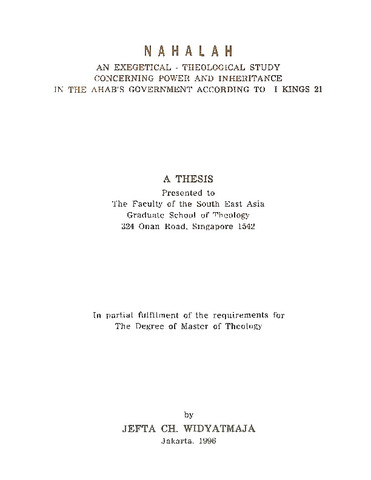
Nahalah: An Exegetical-Theological study concerning power and inheritance in the Ahab's government according to 1 Kings 21
Page views
348Date
1996Share
Metadata
Afficher la notice complèteRésumé
If we read carefully I Kings 21, a question arises regarding the taking over of Naboth's inheritance bordering to the land of Ahab, the king of Samaria. Naboth is defending his land vehemently. He understands that his land is Nahalah from Yahweh which can't be exchanged or be sold. On the other hand, Ahab wants to possess Naboth’s Vineyard. He, moreover, wants to exchange it with another vineyard or to pay it with money.
The problems in 1 Kings 21 will be dealt with in this thesis. So the title of this thesis is NAHALAH - An Exegetical-theological Study concerning Power and Inheritance in the Ahab's Government according to I Kings 21.
The Old Testament clearly stated, that Yahweh, the Creator of heaven and earth, is the Owner of this universe. Everything in this universe in His power.
Yahweh entrusted to humankind to take part in managing and taking care of His creation. Therefore, humankind is not in power to own God's universe and to exploit it without any limitation. One of God's belongings for which man is responsible, is the land. This land belongs to Yahweh so it may not be sold (Lev.25:23). If this land is traded, catastrophe and death will be the punishment. The land of Yahweh should be handed down from one generation to the other. And this land is called NAHALAH.
NAHALAH generates the value of loyalty both to Yahweh who entrusted the land and to the forefather of the family. This is t h e underlying attitude of Naboth's decision of his refusal of Ahab's request to buy or to exchange his vineyard. Naboth, the one who is in the Yahweh religion, knows that nahalah is Yahweh's property. On the other hand, Ahab affected by his wife, Jezebel from Sidon, and adopting the values of Baal's religion (I Kings 16:29-34). does not recognize Naboth’s religious values and he treats Naboth’s vineyard only as a comidity, that can be traded freely.
These conflicting opinions about the vineyard as nahalah have caused subsequent tensions. In a conflict usually the weaker is the loser. That's what has happened to Naboth.
Naboth is executed and his nahalah is seized by Ahab and Jezebel. But Yahweh sends Elijah to admonish Ahab for his doing wrong, and to announce His judgement to Ahab and his family. The same tragic death of Naboth will befall the King and his family.
Through the passage of 1 Kings 21 and the question of nahalah, we could address the problems of land, power, and justice. Nahalah is an inherited land which has spiritual value related both to Yahweh and to the family clan. It seems that this nahalah idea exists in Indonesia, too. In the Indonesian society for many people staying in family’s land is preferable than leaving it, even though one must live in poverty. That’s why, the transmigration program in Indonesia of ten faces many obstacles.
On the other hand, the fast physical development in Indonesia has caused disturbance among many people who feel safe and secure in their family's home and on their forefather's land. Many common people must be unwillingly giving their, land with very cheap price to strong people who have power. They are common people like Naboth. They are unable to face the power. The result is they become the victims of power.
What we understand of Indonesia is that this country is based on law. The law must be upheld in this country. And if the law is strong and upright in this country, of course everybody will get the same treatment in front of the law, and shall also be protected by law in all areas of life.
So, what can the church do to make all these things true? It should be able to do as Jesus did (cf. Luk.4:18-19). What he said has been made real through his life and service. The Church should have genuine attention and care for the poor people, the captured people, the small people, the oppressed people, and people without legal aid. The Church must give better advocation to those people.
Description
Abstract only
Suggested Citation
Widyatmaja, J. C. (1996). Nahalah: An Exegetical-Theological study concerning power and inheritance in the Ahab's government according to 1 Kings 21 [Unpublished master's thesis]. South East Asia Graduate School of Theology.
Type
ThesisSujet

Keywords
Department
South East Asia Graduate School of TheologyDegree
Master of TheologyShelf Location
BT 212 .W53 1996
Physical Description
89 leaves
Collections
- Master of Theology [75]