
Ipakita ang simpleng tala ng item
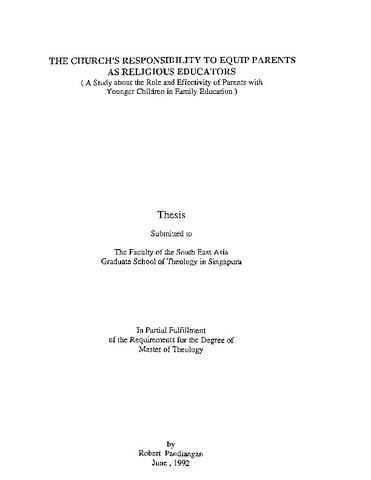
The Church's responsibility to equip parents as religious educators: A study about the role and effectivity of parents with younger children in family education
| dc.contributor.adviser | Ismail, Andar | |
| dc.contributor.author | Pandiangan, Robert | |
| dc.date.accessioned | 2025-08-04T02:30:26Z | |
| dc.date.available | 2025-08-04T02:30:26Z | |
| dc.date.issued | 1992-06 | |
| dc.identifier.citation | Pandiangan, R. (1992). The Church's responsibility to equip parents as religious educators: A study about the role and effectivity of parents with younger children in family education [Unpublished master's thesis]. South East Asia Graduate School of Theology. | en_US |
| dc.identifier.uri | https://hdl.handle.net/20.500.12852/3459 | |
| dc.description | Abstract only | en_US |
| dc.description.abstract | This study discusses the church's responsibility and church's effort to educate parents who have children under five years of age. The first step of the discussion is the theological background of parental education. According to the Bible, parents are fully responsible for bringing up family members in religious education. Although, schools have been founded, especially after exile period, but the parental role was still most urgent and was the principle method in children's development. Because of this important role of the parents, priest, prophet and wise men were instrumental in parental education. Also, in the early Christian community the parental role was very urgent, because at that time Christian education was focused around the family. Besides, the early Christian community did not have any special formal institution for schooling. In chapter two, this study presented the observation o f s even educators, namely Chrysostom, Martin Luther, Comenius Rousseau, Pessalozzi, Frobbel and Bushnell . All of them stressed the responsibility of parents in Christian Education. Nine terminologies about the parental role appeared in this historical trace, namely, caretaker, facilitator nu nurturer, guider, controller, trainer, educator, teacher, and priest. But, basically, as it was cleared in this study, the main responsibility of parents to children is to act as religious educators. This role can be simplified as 1) care takers, 2) teachers, 3) friends, and 4) priests. Chapter three discusses the job description. Firstly, the parents need to understand the developmental stages of children, such as p h y sic a l, intellectual, emotional, and religious development. This enables the parents to educate children in accordance with the developmental needs of the children. Secondly, parents should especially understand how to foster the growth of positive feelings, such as safety feeling, achievement and appreciation satisfied feeling, admiration and thanksgiving to God to all creation in the world. Also important is to grow the image of God and parents should build the conscience of the children which will function as internal control. To make this growth effective parents should understand these five principles: 1) the children learn directly from their environment, 2) there should be positive dialogical inter-relation between parents and children, 3) children learn from imitation and look to their parents as the main model, 4) there should be a balance between cognitive, effective psychomotoric development in children, and 5) parents should act as care takers, teachers, friends and priests. This should be realized through examples and actual deeds. The last chapter shows that in the modern society many parents tend to shift the task of educating children to other agencies, such as play groups, baby sitters and Sunday Schools. Many parents feel that they are unable to perform this educational task. For this reason, the last chapter of this study sees the urgent need for the church to help the parents realized their role as educators. This study suggests the church to equip parents with awareness, understanding and know-how as educators. This last chapter also includes a model of parental education designed for a local church. | en_US |
| dc.format.extent | ix, 217 leaves | en_US |
| dc.language.iso | other | en_US |
| dc.publisher | South East Asia Graduate School of Theology | en_US |
| dc.subject.lcc | BT 212 .P36 1992 | en_US |
| dc.subject.lcsh | Religious educators | en_US |
| dc.subject.lcsh | Christian education--Home training | en_US |
| dc.subject.lcsh | Church work with families | en_US |
| dc.subject.lcsh | Parenting--Religious aspects | en_US |
| dc.subject.lcsh | Families--Religious life | en_US |
| dc.subject.lcsh | Christian education--Study and teaching | en_US |
| dc.subject.lcsh | Parenting--Religious aspects--Christianity | en_US |
| dc.subject.lcsh | Religious education of children--Study and teaching | en_US |
| dc.title | The Church's responsibility to equip parents as religious educators: A study about the role and effectivity of parents with younger children in family education | en_US |
| dc.type | Thesis | en_US |
| dcterms.accessRights | Limited public access | en_US |
| dc.contributor.department | South East Asia Graduate School of Theology | en_US |
| dc.description.degree | Master of Theology | en_US |
Mga file sa item na ito
Lumilitaw ang item na ito sa mga sumusunod na (mga) Koleksyon
-
Master of Theology [75]
Mga parehong item
Ipinapakita ang mga item na nauugnay sa pamagat, may-akda, tagalikha at paksa.
-
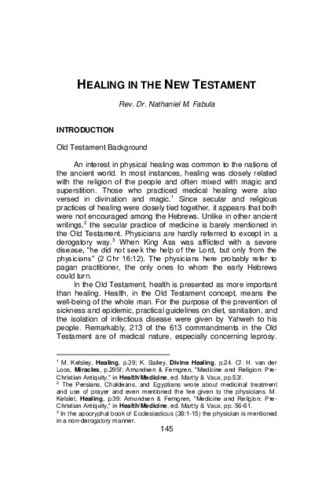
Healing in the New Testament
(Institute of Advanced Theological Studies (IATS) and College of Theology, 2007)An interest in physical healing was common to the nations of the ancient world. In most instances, healing was closely related with the religion of the people and often mixed with magic and superstition. Those who practiced ... -
Family planning and its biblical and theological bases
(1995)Filipino homes today have an average of eight children. Family planning is strongly endorsed by the United Nations for all countries with high fertility rates. In the Philippines today, the government and some private ... -
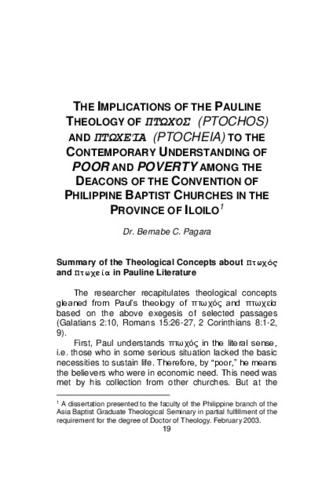
The implications of the Pauline Theology of ΠΤΩΧΌΣ (PTOCHOS) and ΠΤΩΧΕΊΑ (PTOCHEIA) to the contemporary understanding of POOR and POVERTY among the deacons of the Convention of Philippine Baptist Churches in the Province of Iloilo
(Institute of Advanced Theological Studies (IATS) and College of Theology, 2006)The researcher recapitulates theological concepts gleaned from Paul’s theology of πτωχός and πτωχεία based on the above exegesis of selected passages (Galatians 2:10, Romans 15:26-27, 2 Corinthians 8:1-2, 9).