

Ipakita ang simpleng tala ng item
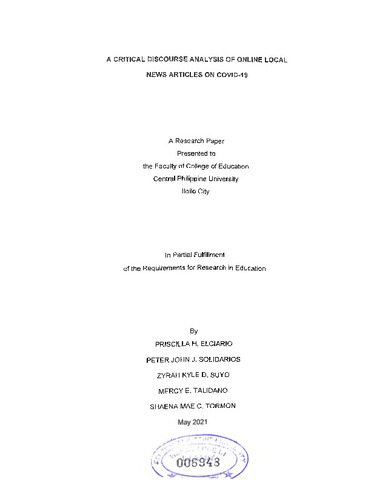
A critical discourse analysis of online local news articles on COVID-19
| dc.contributor.adviser | Cocjin, Annalee L. | |
| dc.contributor.author | Elciario, Priscilla H. | |
| dc.contributor.author | Solidarios, Peter John J. | |
| dc.contributor.author | Suyo, Zyrah Kyle D. | |
| dc.contributor.author | Talidano, Mercy E. | |
| dc.contributor.author | Tormon, Shaena Mae C. | |
| dc.date.accessioned | 2025-07-31T07:02:21Z | |
| dc.date.available | 2025-07-31T07:02:21Z | |
| dc.date.issued | 2021-05 | |
| dc.identifier.citation | Elciario, P. H., Solidarios, P. J. J., Suyo, Z. K. D., Talidano, M. E., & Tormon, S. M. C. (2021). A critical discourse analysis of online local news articles on COVID-19 [Unpublished special paper]. Central Philippine University. | en_US |
| dc.identifier.uri | https://hdl.handle.net/20.500.12852/3454 | |
| dc.description | Abstract only | en_US |
| dc.description.abstract | This study used Fairclough's Critical Discourse Analysis (CDA) to examine online local news articles on COVID-19. Specifically, this study discussed the linguistic features used in news headlines with respect to omission of subjects and auxiliaries, nominalizations, passivization, formation of word order, use of short words, and widespread use of puns and wordplay. This investigation revealed new terminologies as well as the ideologies present in the news articles. The COVID-19 news articles were selected from a major local online news portal and put through a rigorous review process (CDA). The findings revealed that linguistic features such as the omission of subjects and auxiliary verbs, word order formation, the use of short words, and puns and wordplay contribute to more engaging and concise new headlines. While the lack of Nominalization and Passivization characteristics is intended to lead the subject to more direct and objective treatment. The terms "Community Lockdowns," "RT-PCR test," "LSIs," and "Quarantine" were commonly used to describe the COVID-19 pandemic. The news articles revealed that the government maintains the ideologies of both power and security. Power was maintained with the use of force and security through confidentiality. Overall, the authors used precise language to convey their personal perspectives on the subject. It is suggested that a more in-depth discussion of ideologies be conducted from a global perspective. | en_US |
| dc.format.extent | vii, 49 leaves | en_US |
| dc.language.iso | en_US | en_US |
| dc.publisher | Central Philippine University | en_US |
| dc.rights.uri | http://publicdomain.org/publicdomain/zero/1.0/ | * |
| dc.subject.lcc | LB 2326.3 .E43 2021 | en_US |
| dc.subject.lcsh | Critical discourse analysis | en_US |
| dc.subject.lcsh | COVID-19 (Disease) | en_US |
| dc.subject.lcsh | Discourse analysis | en_US |
| dc.subject.lcsh | Online journalism | en_US |
| dc.subject.lcsh | Mass media and language | en_US |
| dc.subject.lcsh | Communication in public health | en_US |
| dc.subject.lcsh | Journalism--Social aspects | en_US |
| dc.subject.lcsh | Local mass media | en_US |
| dc.subject.lcsh | Mass media--Objectivity | en_US |
| dc.subject.lcsh | Mass media--Political aspects | en_US |
| dc.subject.lcsh | Language and languages--Political aspects | en_US |
| dc.title | A critical discourse analysis of online local news articles on COVID-19 | en_US |
| dc.type | Special paper | en_US |
| dcterms.accessRights | Limited public access | en_US |
| dc.description.bibliographicalreferences | Includes bibliographical references | en_US |
| dc.contributor.chair | Junsay, Merle | |
| dc.contributor.committeemember | Jardenil, Claire Anne D. | |
| dc.contributor.committeemember | Valaquio, Belinda R. | |
| dc.contributor.department | College of Education | en_US |
| dc.description.degree | Bachelor of Secondary Education major in English | en_US |
Mga file sa item na ito
Lumilitaw ang item na ito sa mga sumusunod na (mga) Koleksyon
-
Special papers [12]