

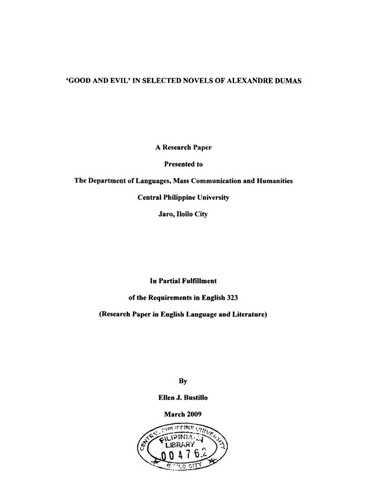
‘Good and Evil’ in selected novels of Alexandre Dumas
Abstract
Background of the Study
God made man good. God formed man in His own image and He was satisfied with what He created as affirmed by these words from the Bible:
Let us make man in our image, in our likeness, and let them rule over the fish of the sea and the birds of the air, over the livestock, over all the earth, and over all the creatures that move along the ground.” So God created man in his own image, in the image of God he created him; male and female he created them (Genesis 1:26-27). God saw all that he had made, and it was very good... (Genesis 1:31).
Despite this likeness to the image of God’s goodness, the tendency towards evil reveals the humanness of man’s being. The dissatisfaction of not having and knowing everything gave man curiosity. The desire to have what he wants triggers man to do unacceptable acts. Good and bad human behaviors exist because people have more wants than needs. Luxury, fame, power, revenge are just among the list of these “things”. People’s ambition to succeed, compete with others even with God, the use of freedom and authority to do good or to indulge in evil are topics in literature. Literature is a product of a person’s thoughts, imagination and feelings expressed in words. It is a favorite source of information because it is a reflection of people’s experiences. A literary work presents situations in reality that can give morals to the readers. This purpose of literature provides understanding of morality which can be developed by society and adopted by an individual. If a person already realizes the morals of a literary work, this may change his behavior towards himself, others, and society. This may also influence a person’s total personality and behavior. In the present world, there are observable conflicting behaviors of people. These are evident in the fields of politics, religion, education, economy, and others. It is in this premise that the concept of this study is built upon. Hence, the interest in using literature to study these conflicting phenomena is a justification for making this research.
Objectives of the Study
This study aimed to analyze the theme of good and evil in selected novels of Alexandre Dumas, namely: “The Count of Monte Cristo”, “The Three Musketeers”, and “The Man in the Iron Mask ” Specifically, it answered the following questions: 1. How are good and evil depicted in the main characters of the novels? 2. What universal truths about good and evil are emphasized in the novels?
Suggested Citation
Bustillo, E. J. (2009). ‘Good and Evil’ in selected novels of Alexandre Dumas [Unpublished special paper]. Central Philippine University.
Type
Special paperSubject(s)

Department
Department of Languages, Mass Communication and HumanitiesDegree
Bachelor of Arts major in EnglishShelf Location
PN 73 .B87 2009
Physical Description
vi, 50 leaves