

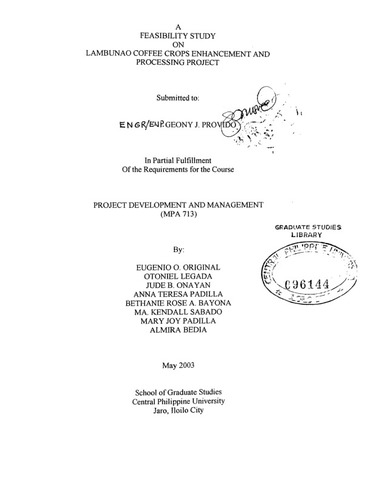
A feasibility study on Lambunao coffee crops enhancement and processing project
Аннотации
Background and Rationale
Coffee is a simple yet organic part of the breakfast table. Either as home brewed, as instant coffee or as an expensive concoction sold in multinational coffee shops, it sure does entice the Filipino taste. These days, coffee drinking is being transformed from simply a way of life to one of a status symbol.
Behind every cup of coffee, however, lies a very tedious job of farming, harvesting, post-harvesting, processing, farm-to-market transporting, grading, cleaning, blending, roasting, grinding for roast and for ground coffee, processing into instant coffee, packing and distribution to wholesalers and retailers, and then finally to our breakfast table.
Coffee is one of the oldest crops produced here in the Philippines. The tree was first known before the year 1740 when it was first planted in Lipa, Batangas. Coffee production peaked in 1880 when the Philippines became the fourth largest exporter in the world.
In 1960, the Philippine government came up with a program aimed at improving the quality of coffee production. As a result, the Philippines further became popular as exporter of coffee, especially when production of major exporters like Brazil & Angola suffered due to extreme cold climate.
In 1980, a new variety called “Robusta” introduced. The variety has good quality and produces higher yield. But in 1990, the International “quota” for coffee was abolished and resulted to a very low price for coffee. As a result, a lot of farmers discontinued coffee production and shifted to other crops. There was also a sudden drop in production in 1990 when the crop was stricken by an epidemic called “Coffee Rust”.
The drink that keeps us Ilonggos awake has it’s own shaking up to do. Presently, the Philippine coffee industry is a slowly dying one. It has not been a profitable undertaking especially since the prices for coffee beans are down. In response, government created the Presidential Task Force on Coffee production in order to revive the sluggish coffee industry. The Department of Agriculture has recognized coffee as one of the “high value commercial crops” in the Gintong Ani Program. Moreover, Nestle’ Philippines is the major buyer of coffee produced under the Gintong Ani Program.
Objectives of the Project
The study sought to determine the feasibility of a Coffee Crop Enhancement and Processing Project in Lambunao Iloilo (CCEPP). The desire for this study has been very timely with the establishment of the National Task Force on Coffee Rehabilitation whose mandate includes revitalizing and rehabilitating 22,000 hectares of coffee farms, establishing and implementing standards of quality coffee production, milling and roasting to be used locally and for exports purposes. Aside from being a valuable material for the Municipality of Lambunao, this study is intended for use by the different players of the coffee industry and as reference material for other LGU’s, NGO’s and others who wish to work on a similar project.
Scope of the Project
This study covers the marketing, technical, financial, economic, environmental, logical framework and institutional aspect of the Coffee Enhancement Program. Basically, this study will show the feasibility of the project in the Municipality of Lambunao, Iloilo.
Study Approach
This study employed the use of secondary data, expert’s opinion, interview, survey, and needs assessment.
The team gathered information and insights from the Department of Agriculture on priority projects of the province. Secondary data on the coffee industry of the Municipality of Lambunao and other pertinent data.
Описание
Introduction
Suggested Citation
Original, E. O. , Legada, O. O. , Onayan , J. B. , Padilla, A. T. , Bayona, B. R. A. , Sabado, M. K. , Padilla, M. J. , & Bedia , A. S. (2003). A feasibility study on Lambunao coffee crops enhancement and processing project (Unpublished Master’s special paper). Central Philippine University, Jaro, Iloilo City.
Type
Special paper
Keywords

Department
School of Graduate StudiesDegree
Master in Public AdministrationShelf Location
GSL Theses 351.072 Or45
Physical Description
130 leaves