
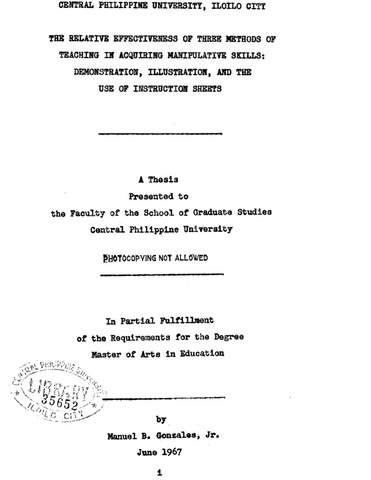
The relative effectiveness of three methods of teaching in acquiring manipulative skills: Demonstration, illustration, and the use of instruction sheets
Abstract
The purpose of this study is to investigate the relative effectiveness of the three methods of teaching manipulative skills; namely, the demonstration method, the illustration method, and the use of instruction sheet method. This study also seeks to find answers involving which of the three methods is most effective among them and which of them is the best suited to the trade technical schools in the teaching of students in acquiring manipulative skills. The researcher hopes that the results of this study might help in some degree the re-evaluation of the philosophy underlying the trade technical school programs and help orient the Iloilo School of Arts and Trades for larger service in the field.
It was hypothesized that the three methods were equally effective. It was decided to adopt the 5 per cent level of significance as the criterion for accepting or rejecting the hypothesis. The analysis of variance of the two-way classification procedure was the basic procedure employed in this study. The data were taken from various sources, such as the college entrance test, (I.Q. and achievement tests) the Philippine prognostic test, and the teacher-made tests of the three methods. Achievement tests were administered in order to measure the achievement of each method. The computations were statistically treated by the application of the critical ratio technique. To determine the reliability coefficient of the tests, the Kuder-Richardson Footrule Formula was employed.
Two groups of students were selected in the first year of the Bachelor of Science in Education Curriculum. It was originally planned to conduct the experiment to two groups of twenty-five students to a group. Due to the decrease in enrolment at the start of the school year, only thirteen students to a group were used or a total of twenty-six students. It was realized that it would be difficult to equate the groups since there were only twenty-six students. The scores of the entrance examination were used in pairing and ranking them. The experiment was so designed that it would be possible to partition the observed variances by means of analysis of variance. Two teachers were selected to help in the experiment.
In this investigation, every effort was made to reduce experimental error. At the close of the experiment, it was found out that:
1. In terms of teachers, the F is 1.612 which is far below at the 5 per cent level.
2. In terms of methods, the F is .761 which is far below 3.49 at the 5 per cent level.
3. In terms of interaction, the F is only .376 which is far below 3.49 at the 5 per cent level.
The following conclusions on the basis of the above results yielded by the three sets of measuring instruments used in the study are:
1. That the teacher factor does not definitely account for the differences in achievement, and the differences between the means of the rows are not also significant.
2. That the factor of method does not definitely account for the differences in achievement, and that the difference between the means of the columns are not significant.
3. That the researcher accepts the null hypothesis in this instance and concludes that there is some compounding between methods and teachers.
The researcher suggests the following recommendations:
1. A replication of the experiment with twenty or more students in a section.
2. Other graduate students be challenged to replicate the experiment in other schools.
3. Other experimental designs be tried besides the two-day classification procedure.
Description
Abstract only
Suggested Citation
Gonzales, M. B. , Jr. (1967). The relative effectiveness of three methods of teaching in acquiring manipulative skills: Demonstration, illustration, and the use of instruction sheets (Unpublished Master’s thesis). Central Philippine University, Jaro, Iloilo City.
Type
ThesisSubject(s)

Keywords
Department
School of Graduate StudiesDegree
Master of Arts in EducationShelf Location
GSL Theses 378.242 G5893
Physical Description
230 leaves
Collections
Related items
Showing items related by title, author, creator and subject.
-
Attendance in English and Math remedial classes: Its influence to students’ academic performance at CPU High School
(2006)This study was conducted to determine the influence of attendance in English and Math Remedial Classes on the academic performance of students at CPU High School during the school years, 2002-2003 and 2003-2004. It ... -
Animated short stories in enhancing students' inferential comprehension skills
(Central Philippine University, 2024-09)This study was conducted to determine the effectiveness of animated short stories in enhancing students’ inferential comprehension skills. A purposive sampling of 30 grade 7 students from a public high school in the province ... -
The effect of the use of models and analogies on the performance of freshmen students in earth and environmental science at Romblon State University-San Fernando Campus
(2012)This comparative study using quasi experimental design was conducted to compare the performance of freshmen Bachelor of Science in Hotel and Restaurant Management (BSHRM) students in Earth and Environmental Science at ...