

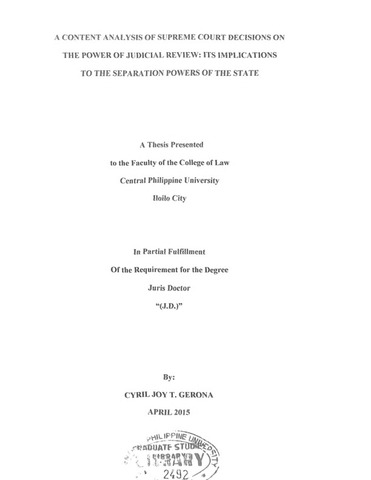
A content analysis of Supreme Court decisions on the power of judicial review: Its implications to the separation powers of the state
요약
The Court is part of the State’s check-and-balance machinery, specifically mandated by Article VIII of the 1987 Constitution. Section 1 Article VIII of the 1987 Constitution expanded the scope of judicial power by mandating that the duty of the courts of justice includes not only “to settle actual controversies involving rights which are legally demandable and enforceable” but also “to determine whether or not there has been a grave abuse of discretion amounting to lack or excess of jurisdiction on the part of any branch or instrumentality of the Government” even if the latter does not exercise judicial, quasi-judicial or ministerial functions.
This study was conducted on the Supreme Courts power on judicial review as expressly stated in the 1987 Constitution; under Section 1 Article VIII and Section 4 paragraph (2) Article VIII; its duty to pass judgment on matters of this nature. In what cases and controversies can the Supreme Court wield its power of judicial review: To define the power of judicial review is it is the power of the courts to test the validity of the executive and legislative acts in light of their conformity with the Constitution.
The objectives of the study is to appreciate the interference of the Judicial Department of our Constitution the system of checks and balances, in cases of grave abuse of discretion in any branch or instrumentality of the Government. The separation of powers is a fundamental principle in our system of government, which obtains not through express provision but by actual division in our Constitution. With the end in that we can maintain a good government to maintain its existence. The methods that were used in this study is the express provisions of the Constitution, the decisions of the supreme court for ten (10) years in the Years of 2003 to 2013, the opinions of the well-respected authors and authorities of constitutional law for ten (10) years in the Years of 2003 to 2013. The procedural aspect, the merits, the courts power of Judicial Inquiry, the issue of Constitutionality of an acts, statutes, treaty, law, regulation, and ordinance (Section 5(2) Article VIII) or under Section 1, Article VIII. What is important is that a case must fulfill the four requisites of judicial review. Even though there may be instances that the court will relax one of the requisites or the technicalities in view to dispense justice as it depends on the merits of the case.
The sampling design, the study used was the Simple Random Sampling or The Lottery Technique. So out of seventy eight cases, there were twenty four cases for the in depth content analysis of Judicial Review of Constitutional Cases. These cases are significant and transcendental. The probability of thirty one percentage allocation results in these twenty four landmark cases, presented in this study.
기술
Abstract only
추천 인용
Gerona, C. J. T. (2015). A content analysis of Supreme Court decisions on the power of judicial review: Its implications to the
separation powers of the state (Unpublished postgraduate thesis). Central Philippine University, Jaro, Iloilo city.
유형
Thesis주제

학과
College of Law정도
Juris Doctor선반 위치
GSL Theses 340.72 G319
물리적 설명
iii, 144 leaves
Collections
- Juris Doctor [144]