
Hydrological characteristics assessment of Jalaur River system and its bottom sediments, Province of Iloilo, Panay Island

Abstract
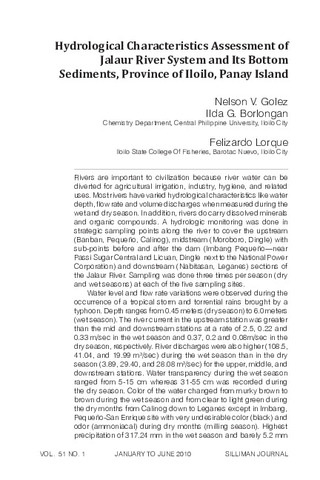
Rivers are important to civilization because river water can be diverted for agricultural irrigation, industry, hygiene, and related uses. Most rivers have varied hydrological characteristics like water depth, flow rate and volume discharges when measured during the wet and dry season. In addition, rivers do carry dissolved minerals and organic compounds. A hydrologic monitoring was done in strategic sampling points along the river to cover the upstream (Banban, Pequeño, Calinog), midstream (Moroboro, Dingle) with sub-points before and after the dam (Imbang Pequeho—near Passi Sugar Central and Licuan, Dingle next to the National Power Corporation) and downstream (Nabitasan, Leganes) sections of the Jalaur River. Sampling was done three times per season (dry and wet seasons) at each of the five sampling sites.
Water level and flow rate variations were observed during the occurrence of a tropical storm and torrential rains brought by a typhoon. Depth ranges from 0.45 meters (dry season) to 6.0 meters (wet season). The river current in the upstream station was greater than the mid and downstream stations at a rate of 2.5, 0.22 and 0.33 m/sec in the wet season and 0.37, 0.2 and 0.08m/sec in the dry season, respectively. River discharges were also higher (108.5, 41.04, and 19.99 m3/sec) during the wet season than in the dry season (3.89, 29.40, and 28.08 m3/sec) for the upper, middle, and downstream stations. Water transparency during the wet season ranged from 5-15 cm whereas 31-55 cm was recorded during the dry season. Color of the water changed from murky brown to brown during the wet season and from clear to light green during the dry months from Calinog down to Leganes except in Imbang, Pequeño-San Enrique site with very undesirable color (black) and odor (ammoniacal) during dry months (milling season). Highest precipitation of 317.24 mm in the wet season and barely 5.2 mm during the dry season was recorded. Bottom sediments were found to be sand to sandy loam, to silty loam from upstream to downstream, respectively. Soil pH was neutral to slightly basic (7.10-8.17). Available phosphorus measurements were higher (11.22-30.50 ppm P) in soils from Calinog to Leganes while the amount of available iron (Fe) increased as the concentration of acetate soluble sulfate decreased, except in Moroboro, Dingle and Nabitasan, Leganes that showed an abnormal increase twice the initial value. The organic matter content of the sediments taken from all sampling sites yielded a wide range of 1.31—4.53 % that decreased to 0.04 from 2.46 % in all sampling sites from wet to dry season. Highest value was in the midstream with values ranging from 4.53—2.46 %.
The results of this study show that sediment agitation by recreational activity and storm surges associated with the drycold season are responsible for the impact on water quality and not recreational users directly. This implies that a follow up study and continuous monitoring is needed to ensure the safety of all end users of the river system, otherwise its use in the future will be limited to quarrying of concreting and embankment materials for civil work projects.
Description
Journal article
Associated Content
Full text of Silliman Journal Volume 51(1), January to June 2010Suggested Citation
Golez, N. V., Borlongan, I. G., & Lorque, F. (2010). Hydrological characteristics assessment of Jalaur River system and its bottom sediments, Province of Iloilo, Panay Island.Type
ArticleISSN
00375284Subject(s)

Keywords

Collections
- Journal articles [14]
Related items
Showing items related by title, author, creator and subject.
-
Proposed 1200 meters construction of diversion road and revetment wall along Aklan river in Poblacion Kalibo, Kalibo, Aklan
(2006)This study on the proposed construction of the diversion road and revetment wall along the Aklan River was conducted in the Poblacion of Kalibo. Its purpose was to provide the structural design and details of the diversion ... -
Jalaur River Multipurpose Project Phase II (JRMP II): It’s acceptability to the indigenous peoples
(2013)Over the years, social acceptability of development projects proved to be crucial for the success of their implementation. A preliminary study was conducted between 2012 and 2013 to determine the acceptability of the Jalaur ... -
A study on the invertebrate and vertebrate biodiversity of the Jalaur River system of Iloilo, Panay, Philippines
(Silliman University, 2010-01)This study, conducted from July to November 2009, aimed to explore the diversity of large aquatic and terrestrial organisms found in microhabitats along the Jalaur River System on Panay Island, Philippines. We adopted a ...