

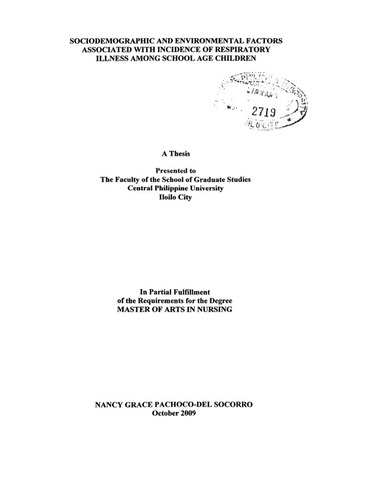
Sociodemographic and environmental factors associated with incidence of respiratory illness among school age children
Abstract
This study aimed to determine the relationship between the sociodemographic and environmental factors associated with incidence of respiratory illness among school age children. This is a retrospective study using secondary data that were analyzed from the information gathered during the Public Health Survey of the Social Science Research Institute (PHSSSRI) of Central Philippine University (CPU). Data of this study were school age children (6-12 years old) from two hundred seventy-nine households (279) of three barangays namely: Hinactacan, Ticud, and Baldoza. Data were collected through face to face interview using a structured interview schedule. The data were computered-processed using SPSS software.
The majority of the respondents are children between 6 to 9 years old from 5 or more members with a family income of P10, 000 and below.
The respondents environmental situation according to the respondents age, household size, and family income showed that majority of the respondents used a water-sealed type of toilet, had a garbage collector to dispose their trash, and bought their water from peddlers and water refilling station. Furthermore, the study also showed that most of the respondents have environmental pollutants in their area. These revealed the kinds of pollutants present in their surroundings: stagnant water, pigpen, chicken pen, and stock of garbage.
As for incidence of illness and respiratory illness, majority of the children were sick but most of them do not have respiratory illness.
As to the relationship of socio-demographic characteristics and environmental factors source of drinking water is the only variable co-related to household size and type of toilet, garbage disposal, and presence of pollutants are significantly related to family income.
Data further revealed that the relationship between socio-demographic characteristics and incidence of respiratory illness show that age and household size are significantly related to respiratory illness. The relationship between environmental factors of the respondents and incidence of respiratory illness show that presence of pollutants is significantly related to incidence of illness and respiratory illness.
Conclusions
In the light of the findings of the study, the following conclusions and generalization were derived.
The respondents were young who belonged to large families with low income were living in a highly polluted area.
Great majority of the respondents have sanitary type of toilet and proper garbage disposal and most of the households buy from water peddlers which can easily be contaminated, thus exposing the young ones to greater health risk. Although high majority of the respondents got sick most of the respondents did not suffer from respiratory illness.
No significant relationship was found between household size and environmental factors such as type of toilet, garbage disposal, and presence of pollutants. This means that the above environmental factors were not influenced by the respondents’ household size while source of drinking water is significantly related with respondent’s household size. This means that the respondent’s source of drinking water is associated with the number of members in the household. This indicate that the more members the less they can buy sanitary water. These findings support the Epidemiologic Triad Model that the host is affected by his socio-demographic characteristics and environment.
No significant relationship was found between family income and water source. This means that water source was not influenced by the respondents’ family income while other environmental factors such as type of toilet, garbage disposal and presence of pollutants in the surroundings were significantly related to the respondents’ family income. The findings support the study of Bayram, et al, 2004 which said that low socioeconomic status affects a family by creating poor living conditions and children are not properly fed, receiving insufficient and unbalanced diet. Furthermore, because treatment and follow-up are not available, infections may be frequent.
No significant relationship was found between respondents’ socio-demographic characteristics such as age, household size, family income and incidence of illness. This means that incidence of illness is not influenced by the respondents’ socio-demographic characteristics.
No significant relationship was found between respondents’ socio-demographic characteristics such as family income and incidence of respiratory illness. This means that incidence of respiratory illness is not influenced by the respondents’ family income while age and household size are significantly related with incidence of respiratory illness. This implies that age and household size is a factor found to significantly influence the respondents’ respiratory illness. This findings confirm the study conducted by Yamada, S. et. Al (1999) and Bayram which state the incidence of respiratory illness is high among 6-10 years old and poor housing condition increased the risk of respiratory illness if 6 or more persons were living in a cramped condition.
No significant relationship was found between environmental factors such as type of toilet, garbage disposal, water source, and incidence of illness. This implies that the environmental factors mentioned do not significantly influence the incidence of illness while the presence of pollutants significantly influences the incidence of illness. This result is supported by the July 2002 publication of Population Reference Bureau (PRB) there is a policy with regard to the “Emerging Policy Issues in Population, Health, and Environment series”, which states that exposure to indoor pollutants, can cause or aggravate ARIs, including upper respiratory infections such as colds and sore throats, and lower respiratory infections such as pneumonia. Other factors that can worsen ARIs include inadequate housing and poor hygiene conditions, overcrowding, and reduced access to health care. Outdoor pollutants such as sulfur dioxide, ozone, nitrogen oxide, carbon monoxide, and volatile organic compounds come mainly from motor vehicle exhaust, power plant emissions, open burning of solid waste, and construction and related activities.
No significant relationship was found between environmental factors such as type of toilet, garbage disposal, water source and incidence of respiratory illness. This means that the environmental factors mentioned above do not significantly influence the incidence of respiratory illness while presence of pollutants significantly influences the incidence of respiratory illness. The result of the study confirms the study conducted by the Environmental Health scientists from the World Health Organization and Boston University factors were discovered that cause respiratory illness in children such as polluted indoor and outdoor air, contaminated water and lack of adequate sanitation, chemical and other toxic hazards, disease vectors, ultraviolet radiation and degraded ecosystems are all important environmental risk factors affecting children around the world.
Description
Abstract only
Suggested Citation
Del Socorro, N. G. P. (2009). Sociodemographic and environmental factors associated with incidence of respiratory illness among school age children (Unpublished Master's thesis). Central Philippine University, Jaro, Iloilo City
Type
ThesisSubject(s)

Keywords


Department
School of Graduate StudiesDegree
Master of Arts in NursingShelf Location
GSL Theses 610.73072 D387
Physical Description
xvi, 62 leaves