
Показать сокращенную информацию
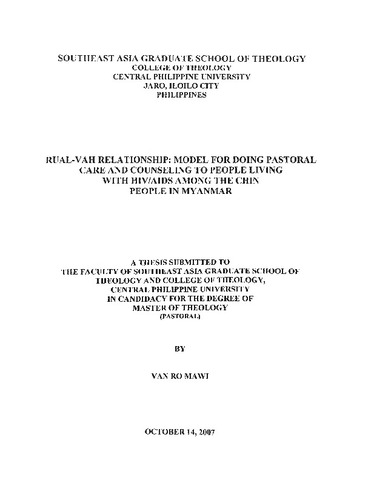
Rual-vah relationship: Model for doing pastoral care and counseling to people living with HIV/AIDS among the chin people in Myanmar
| dc.contributor.adviser | Equiña, Limuel R. | |
| dc.contributor.author | Mawi, Van Ro | |
| dc.date.accessioned | 2026-11-25T06:05:06Z | |
| dc.date.available | 2026-11-25T06:05:06Z | |
| dc.date.issued | 2007-10-14 | |
| dc.identifier.citation | Mawi, V.R. (2007). Rual-vah relationship: Model for doing pastoral care and counseling to people living with HIV/AIDS among the chin people in Myanmar [Unpublished master's thesis]. South East Asia Graduate School of Theology. | en |
| dc.identifier.uri | https://hdl.handle.net/20.500.12852/4079 | |
| dc.description | Abstract only | en |
| dc.description.abstract | HIV/AIDS is now declared a global emergency. It demands the attention of all disciplines, departments and organizations. The Chin people, about 20 years ago, thought that HIV/AIDS s the sickness of a few sinners in a western countries. HIV/AIDS has now infected the whole Chin community. Piang Lilian, a HIV/AIDS worker in the Chin State, said “If you visit any town and village, it is hard to find anyone whose relatives, neighbors, or friends have not been affected by the disease.” Therefore, it becomes a serious challenge to the Christian church and theological institution, especially to pastors and caregivers. People living with HIV/AIDS are most desperate and isolated if not rejected persons in the Chin community because of the cultural and religious view of the community about HIV/AIDS, that is that HIV/AIDS is the result of sin if not a punishment of God. The Rual-vah model of pastoral care and counseling is a cultural approach that attempts to correct the notion and to re-affirmthe worth and dignity of human beings. Rual-Vah relationship in the Chin culture is a relationship with love, acceptance, respect, obedience, empathy, genuineness, trust and self-sacrifice. It is a relationship of companionship and journeying together. The rual-vah model of doing pastoral care and counseling which is adopted from the rual-vah relationship of the Chin culture is a client-centered and supportive kind of counseling where the role of the counselor is a professional friend. It is a culturally accepted norm that provides the space for grace and mercy in the midst of pain and suffering. The Rual-vah relationship model of pastoral care and counseling is relevant for the Chin people, especially for people living with HIV/AIDS. In order to build this rual-vah relationship bridge with people living with HIV/AIDS, counselors need to initiate rule relationship to them. In this model, the clients are made to experience acceptance, belongingness, confident and trust so that they can be able to communicate the deep, intimate aspect of their lives to the counselors. Pastors of the Chin people who deal HIV/AIDS crisis in their daily ministries can adopt the rual-vah model of pastoral care and counseling using the spiritual resources for doing pastoral care and counseling to people living with HIV/AIDS as well as to people who need help. The author recommends pastors and caregivers to apply this rual-vah model of pastoral care and counseling in their ministries. | en |
| dc.format.extent | 127 leaves | en |
| dc.language.iso | en | en |
| dc.publisher | South East Asia Graduate School of Theology | en |
| dc.subject.lcc | BT 212 .M39 2007 | en |
| dc.subject.lcsh | Example | en |
| dc.subject.lcsh | Pastoral care | en |
| dc.subject.lcsh | Counseling | en |
| dc.subject.lcsh | HIV/AIDS care givers | en |
| dc.subject.lcsh | Chin | en |
| dc.title | Rual-vah relationship: Model for doing pastoral care and counseling to people living with HIV/AIDS among the chin people in Myanmar | en |
| dc.type | Thesis | en |
| dcterms.accessRights | Limited public access | en |
| dc.description.bibliographicalreferences | Includes bibliographical references | en |
| dc.contributor.department | South East Asia Graduate School of Theology | en |
| dc.description.degree | Master of Theology (Pastoral) | en |