

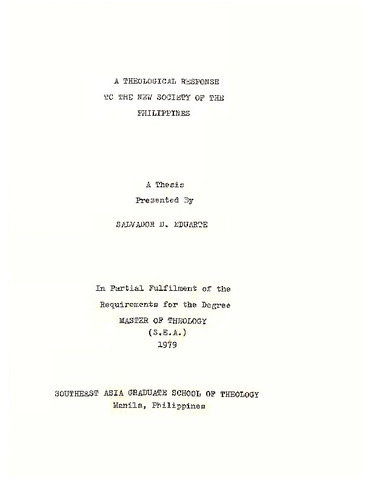
A theological response to the new society of the Philippines
Abstract
On September 21, 1972, Philippine President Ferdinand E. Marcos proclaimed martial law. This historic decision of the President was based, he said on two considerations: he intended to save the Republic of the Philippines from a threat of insurrection and rebellion and anarchy but he also wanted to remove the causes of rebellion by instituting measures to promote economic and social reforms which, he believes, will result in an entirely transformed social order which he calls the New Society.
This paper attempts to examine the political, social and theological implications of this phenomenon. While the New Society is apparently a political development, it has theological overtones in its treatment of political detainees, more so in cases where there are evidences of flagrant violations of human rights. The paper is given in the hope that the other side of the New Society will be examined un- biasedly based on documents and sources from "both the government and the opposition viewpoints.
There are limitations in the scope of the study. Because the New Society is a constantly moving process effecting as it does the entire social fabric of the Philippines— there are recent developments which are not treated at all in this paper. Necessarily, a study such as this must be undated by the more recent developments, but suffice it to say that what is given here is a summation at least of the first seven years of the existence of the New Society.
It is the contention of this -paper that individual rights of citizens should be placed over and above state rights, and that man, as made and created in the image of enjoys a high value in the scale of national development that his rights cannot be sacrificed on the altar of national security. Moreover, the New Society claims to protect human rights, but there seems to be a gap between what is professed and what is practiced.
The main focus of this paper is, therefore, on the apparent credibility gap between Mr. Marcos' promises of a New Order and the apparent lapse into the evils and weaknesses of the repudiated political order, such as the re- turn to the old practice of political patronage, influence peddling, and the concentration of wealth among the favored few.
This paper also suggests that a constant vigilance on military abuses against helpless civilians be done and that unrelenting effects of purging the misfits in the military ranks be instituted to gain the prestige and respect that every citizen ought to have for the Armed Forces.
It is with fervent hope that we offer a prayer that the New Society will be instrumental in achieving the re- forms that are long overdue, but at the same time we recognize the temptation to make the New Society as an idol that promises to solve man's paradoxical dilemmas. To that ex tent, theology must wage an unrelenting battle against false absolutes, both against human pretenses, as well as against human institutions that tend to usurp the honor that is due the one true God.
Description
Abstract only
Suggested Citation
Eduarte, S.D. (1979). A theological response to the new society of the Philippines [Unpublished master's thesis]. South East Asia Graduate School of Theology.
Type
ThesisSubject(s)

Department
South East Asia Graduate School of TheologyDegree
Master of TheologyShelf Location
BT 212 .E38 1979
Physical Description
124 leaves
Collections
- Master of Theology [106]