
Ipakita ang simpleng tala ng item
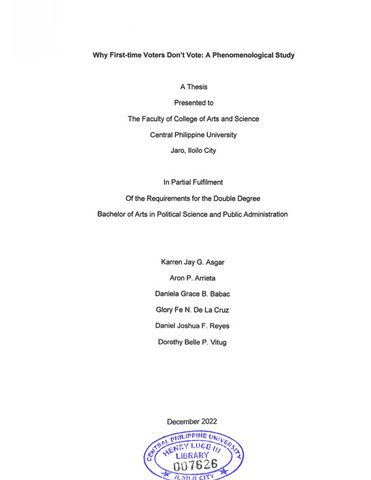
Why first-time voters don't vote: A phenomenological study
| dc.contributor.adviser | Baliguat, Bernadine T. | |
| dc.contributor.author | Asgar, Karren Jay G. | |
| dc.contributor.author | Arrieta, Aron P. | |
| dc.contributor.author | Babac, Daniela Grace B. | |
| dc.contributor.author | De La Cruz, Glory Fe N. | |
| dc.contributor.author | Reyes, Daniel Joshua F. | |
| dc.contributor.author | Vitug, Dorothy Belle P. | |
| dc.date.accessioned | 2026-05-04T07:46:54Z | |
| dc.date.available | 2026-05-04T07:46:54Z | |
| dc.date.issued | 2022-12 | |
| dc.identifier.citation | Asgar, K. J. G., Arrieta, A. P., Babac, D. G. B., De La Cruz, G. F. N., Reyes, D. J. F., & Vitug, D. B. P. (2022). Why first-time voters don't vote: A phenomenological study [Unpublished bachelor's thesis]. Central Philippine University. | en_US |
| dc.identifier.uri | https://hdl.handle.net/20.500.12852/3812 | |
| dc.description | Abstract only | en_US |
| dc.description.abstract | As a registered voter, one should make sure to exercise his or her right to vote, as a human right- that can and will make an impact and a difference. It is one’s obligation to practice his or her right of suffrage. There is a need to look into the minds as well as the experiences of the young people to understand and give importance of political engagement such as voting during the elections. The main objective of this research study was to analyze the experiences of first-time voters from registration and the factors that contributed to their decisions for not voting in the election. The participants were eight (8) college students of Central Philippine University. The data were gathered through an online interview. The stages of data analysis by Colaizzi (1978) were used to explore and understand the phenomenological data collected. The results suggested that: (a) Prioritizing Health and Safety; (b) Conflicts, (c) Disorganized Voting System; and (d) Inconveniences are main factors considered by first-time voters why they did not vote in the recently concluded elections. Subthemes were also formulated: (a), Strict Protocols; (b) Fear of the COVID-19 Infection; (c) Family Pressured; (d) Voter’s Impatient Idealism; (e) Lengthy Lines; (f) Confusion, Chaos, and Unreliability; (g) Poor Contingency Preparedness; (h) The Haphazard Timetable; and (i) Kilometers Away are factors contributing to the participants’ decision. This study recommends that future first-time voters must be prepared for what is in store once they decide to practice their right to vote. They must get rid of the so-called “slack mentality” and come prepared with the advised essentials and preparations. It is also recommended that further studies must be done as there is limited research and literature on the subject. | en_US |
| dc.format.extent | viii, 85 leaves | en_US |
| dc.language.iso | en_US | en_US |
| dc.publisher | Central Philippine University | en_US |
| dc.subject.ddc | Filipiniana Theses 300.72 As29 | en_US |
| dc.subject.lcc | H 91 .A84 2022 | en_US |
| dc.subject.lcsh | Voter turnout | en_US |
| dc.subject.lcsh | Voting research | en_US |
| dc.subject.lcsh | Youth--Political activity | en_US |
| dc.subject.lcsh | Voting--Psychological aspects | en_US |
| dc.subject.lcsh | Qualitative research | en_US |
| dc.subject.lcsh | Young adults--Attitudes | en_US |
| dc.title | Why first-time voters don't vote: A phenomenological study | en_US |
| dc.type | Thesis | en_US |
| dcterms.accessRights | Limited public access | en_US |
| dc.description.bibliographicalreferences | Includes bibliographical references | en_US |
| dc.contributor.committeemember | Rio, Irving Domingo L. | |
| dc.contributor.committeemember | Palomar, Rodel C. | |
| dc.contributor.committeemember | Catolin, Alfonso B. | |
| dc.contributor.department | College of Arts and Sciences | en_US |
| dc.description.degree | Bachelor of Arts in Political Science and Public Administration | en_US |