

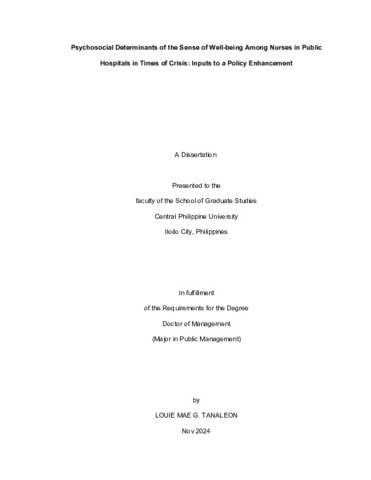
Psychosocial determinants of the sense of well-being among nurses in public hospitals in times of crisis: Inputs to a policy enhancement
Abstract
This study, which aimed to determine the psychosocial determinants of the sense of well-being among nurses in district hospitals in Iloilo, utilized causal non-experimental research. A one-shot survey design was used. The duration for the conduct of study was from November 2023 to February 2024. The study’s respondents were 142 nurses from 11 district hospitals in Iloilo Province. Frequency count, percentage, mean, and standard deviation were employed for descriptive statistics, T-test, ANOVA, Pearson’s r, and multiple regression were used for inferential statistics, all set at a 0.05 level of significance. The results revealed that the respondents have moderate to high emotional intelligence, great extended personal resiliency, and high organizational support. In addition, nurses in district hospitals are predominantly young, female, married individuals with at least 16 years of experience in their profession. Furthermore, the nurses actively participate in spiritual activities several times a day. Interestingly, a fraction of the sample has a moderate sense of well-being, and the majority of nurses in district hospitals have a low level of sense of well-being. However, sex, civil status, length of service, spirituality, and educational attainment were not found to be associated with emotional intelligence, personal resilience, and perceived level of organizational support. Conversely, there were significant differences in the perceived organizational support of nurses based on their age and position. Furthermore, age, sex, civil status, length of service, educational attainment, spirituality, and position of nurses were not associated with the sense of well-being of nurses. In other words, nurses' level of well-being showed no significant association based on personal characteristics. The key finding is that the well-being of nurses in district hospitals is highly correlated with emotional intelligence, personal resiliency, and perceived organizational support. Specifically, Emotional Intelligence has a positive relationship with the sense of well-being; however, Emotional Intelligence alone may not be a strong determinant of nurses' sense of well-being. Perceived Organizational Support is identified as a significant determinant and has a significant relationship with the sense of well-being. This indicates that the nurses who feel and are perceived to have support from the organization will have a better sense of well-being. More importantly, Personal Resilience seems to have a stronger impact on well-being. Nurses with higher levels of Personal Resiliency are more likely to experience a greater sense of well-being. Therefore, Personal resiliency is a critical factor in the nurses' well-being.
Description
Abstract only
Suggested Citation
Tanaleon, L. M. G. (2024). Psychosocial determinants of the sense of well-being among nurses in public hospitals in times of crisis: Inputs to a policy enhancement [Unpublished doctoral dissertation]. Central Philippine University.
Type
DissertationSubject(s)

Department
School of Graduate StudiesDegree
Doctor of Management major in Public ManagementShelf Location
GSL Theses 658.0072 T153
Shelf Location
HD 30.37 .T36 2024
Physical Description
xii, 135 leaves