
Показать сокращенную информацию
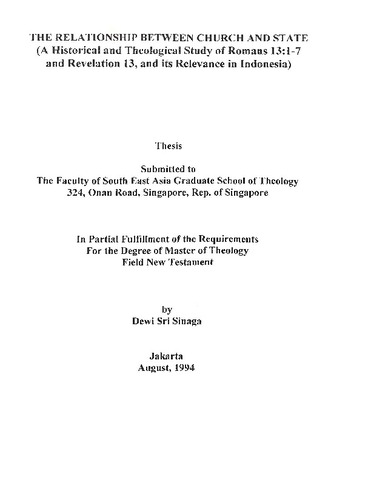
The relationship between church and state: A historical and theological study of Romans 13:1-7 and Revelation 13, and its relevance in Indonesia
| dc.contributor.adviser | Baker, D.L. | |
| dc.contributor.author | Sinaga, Dewi Sri | |
| dc.date.accessioned | 2026-04-01T02:22:53Z | |
| dc.date.available | 2026-04-01T02:22:53Z | |
| dc.date.issued | 1994-08 | |
| dc.identifier.citation | Sinaga, D. S. (1994). The relationship between church and state: A historical and theological study of Romans 13:1-7 and Revelation 13, and its relevance in Indonesia [Unpublished master's thesis]. South East Asia Graduate School of Theology. | en_US |
| dc.identifier.uri | https://hdl.handle.net/20.500.12852/3782 | |
| dc.description | Abstract only | en_US |
| dc.description.abstract | This thesis focuses on the proper relationship between Church and State considered within the historical context of Romans and Revelation and its relevance to the situation in Indonesia. The relationship between the church and government in Indonesia has got worse recently (particularly in relation to the problems of the HKBP). This was the motivation of the author to analyze the historical context of Romans 13:1-7 and Revelation 13, and consider its relevance to the life of the churches in Indonesia, especially the HKBP. The introduction to the thesis describes the background, objectives, and methodology. The next chapter discusses Romans 13:1-7 in its historical context. The general background of Romans is presented, and in particular the background of Paul's life as a Jew and fanatical Pharisee, a Roman citizen, and his vocation as an apostle to the Gentiles. The economic and social situation in the Roman Empire influenced Paul in Romans 13; 1-7, also the social background of the Roman Church and the place and occasion of writing. Paul's teaching on the Christians' attitude to government will be clarified by means of exegesis of the text. Paul demanded loyalty based upon συνείδησις (conscience). The Christians have responsibility to the state should be heart felt, because it is based upon their loyalty to God. This is possible if the churches and the government admit that the government's authority comes from God, therefore they are ministers of God to serve people. The loyalty demanded by Paul in Romans 13:1-7 is balanced by John's view of loyalty to the government in Revelation 13. Therefore the background of Revelation 13 will be dealt with, concerning the social life of the church in Asia at that time. By means of exegesis of John's symbols, the churches' struggle at that time can be identified and understood. At that time there were problems arising from within the church itself (Christians who denied their faith and turned against the church) and also from outside the church (civilian power from the government which opposed, tortured, and killed Christians who refused to worship the emperor). In the face of such opposition, Christians in Asia were challenged to prove their dedication and loyalty to Jesus Christ. The exegetical section notes how the Christians' attitude should be, to a government that had forced its own will on the people and ignored human rights. John reminded Christians of the possibility that the state would turn against God and become an instrument of evil, so that it no longer acted as the minister of God, governing dictatorially and with ruthless cruelty, encroaching on God's authority. In this situation Christians should have the courage to resist orders to worship the emperor and should stay loyal to Christ whatever the cost. It is clear that there are two different points of view concerning the Christians' attitude to government in the New Testament, due to different historical contexts, but one is not against the other. The loyalty taught by Paul in Romans 13:1-7 shows a positive theological attitude to the Roman government at that time. Whereas, John has a negative attitude to the Romans government in Revelation 13, because the government has turned against God and posed a threat to the life of the church. His remarks are not intended to contradict Romans 13:1-7, but to balance Paul's teaching in a different context. Paul and John had different opinions but not were against each other. Loyalty to state or government must be based upon (juveiSrcng (conscience), common sense, ingenuity, and critical analysis. It should not be because of fear of government threats but because of dedication and loyalty to God. Christians should not oppose a government which is loyal to God, only one which is in opposition to Him. To understand the relevance to Indonesia, the tense relationship between church and state at present (particularly concerning the problems of the HKBP) is presented. It seems the churches are unable to show their loyalty in facing the problems arising from the social, government and state. Hence, it is necessary to ask why they are not able to show their faith clearly and firmly in the present situation. May be the church's understanding of loyalty in Romans 13:1-7 and Revelation 13 is inadequate. Perhaps also the state does not realize their position as the minister of God and recognize appropriate limits to the involvement in church life. It is concluded that the government's good intentions in trying to solve the problems of HKBP did not accomplish a great deal, because of their being unable to understand the rules of the church and the use of inappropriate methods. It would be much better if both church and state recognize each other's existence and respect each other's rights in accordance with their respective rules, laws, and ideology. If this happens there could be a harmonious relationship between church and state in this complex nation. Moreover, the objectives of government policy and the orientation of churches in Indonesia would be attained in accordance with the will of God. | en_US |
| dc.format.extent | viii, 178 leaves | en_US |
| dc.language.iso | other | en_US |
| dc.publisher | South East Asia Graduate School of Theology | en_US |
| dc.subject.lcc | BT 212 .S56 1994 | en_US |
| dc.subject.lcsh | Bible | en_US |
| dc.subject.lcsh | Comparative studies | en_US |
| dc.subject.lcsh | Church and state--History of doctrines | en_US |
| dc.subject.lcsh | Church and social problems | en_US |
| dc.subject.lcsh | Indonesia | en_US |
| dc.title | The relationship between church and state: A historical and theological study of Romans 13:1-7 and Revelation 13, and its relevance in Indonesia | en_US |
| dc.type | Thesis | en_US |
| dcterms.accessRights | Limited public access | en_US |
| dc.description.bibliographicalreferences | Includes bibliographical references | en_US |
| dc.contributor.department | South East Asia Graduate School of Theology | en_US |
| dc.description.degree | Master of Theology | en_US |
| local.subject | Revelation 13 | en_US |
| local.subject | Romans 13:1-7 | en_US |