

Показать сокращенную информацию
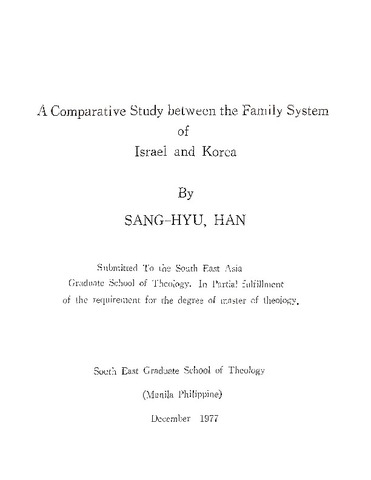
A comparative study between the family system of Israel and Korea
| dc.contributor.adviser | Kim, Chung Choon | |
| dc.contributor.author | Han, Sang-Hyu | |
| dc.date.accessioned | 2026-03-31T03:47:09Z | |
| dc.date.available | 2026-03-31T03:47:09Z | |
| dc.date.issued | 1977-12 | |
| dc.identifier.citation | Sang-Hyu, H. (1977). A comparative study between the family system of Israel and Korea [Unpublished master's thesis]. South East Asia Graduate School of Theology. | en_US |
| dc.identifier.uri | https://hdl.handle.net/20.500.12852/3777 | |
| dc.description | Abstract only | en_US |
| dc.description.abstract | "To make the Christian faith our own in Asia" is the motive for writing this thesis. This is, therefore, an indigenous approach for studying OT = an approach at OT interpretation in the light of the particular Asian context which has been dominated by Confucianism as a principle of social mores. The family is in fact the original form of society. To understand the Israelite family system in OT is to know the Israelite community life and their thought, a comparative study of the Israelite and Korean family systems will help the Korean to understand OT clearly. First, principaly involved in this study are five inter-related areas: (a) family structure, (b) family rites, (c) family values, (d) family relationship, and (e) theological significances. Secondly, the Israelite family system is analysed on the bases of the J, E, and, D documents. And it compared with the family system respectively recorded in J, E, and D in chronological order, and in conclusion synthesized. The Korean family system, meanwhile, is demonstrated from the end of Yi Dynasty, which is prior to the introduction of Western family values, considering historical transitions. The results of this study follow: Both countries adopted the extended patriarchal family system. The family consisted of several generations or sub families, under a male head. They called the family "House" (father’s house in Israel and our house in Korea) which is referred to here not as a group but as an institution of family values. This super timed patriarchal institution included not only the living members, but also both the remote ancestors and the future offspring. The two family structure differs considerably in composition of family members. In Korea it is an established custom that only consanguineous persons are regarded as family members, while in Israel non-sanguineous persons, servants or passengers, are included as family members when they can play a necessary part in the family. Therefore it can be noted that the Israelite had catholicity in their family system in contrast to the Korean's restrictive family system. The father, called "Master" or "Elder" has been ruled over the others of the family and his authoritative right has been taken for granted in both countries. He officiates in all such ceremonies as family worship, marriage and funeral on the hand and he is responsible for the ultimate decision on family affairs like marriage, choice of occupation etc. Particularly, with Korean family the inheritance of the right of ancestor worship is deemed more important than that of the headship of the family or of property, as it is virtually the succession to the family status. The duty of inheritance of ancestor worship is limited to the eldest son. In Israel family however the inheritance of blessing right was thrown into shadow by the inheritance of property, this being the most primary. And because of favoritism the inheritance went to the youngest son in spite of the law that protected primogeniture. Filial piety is the controlling essence of the stable of family. In both countries it is not mere dutifulness to one’s parents but a natural consequence of affection for the parents and an integral approach to what it means to be human. However, both countries have different bonds of filial piety in that in Korea it is usually satisfied through the behaviour of the person while in Israel it is sublimed into the Yahweh faith. Chastity was actually recognized as the crown of sex mores in both countries. Under the patriarchal family idea, the woman's chastity was her life. But in Korea this idea was extended even after marriage so that divorce was strictly restricted under all conditions. The remarriage of a widow is mercilessly forbidden. This is considered not only a great shame to her but also a dishonor to her family. The women's status in both countries is terribly lower than that of contemporary women in neighboring countries. As regards marriage, both countries had the basic idea that marriage is simply to strengthen the existing family rather than to create a new family. By marriage the two families are allied and at the same time the husband’s family is strengthen. There is a difference, however, in that a radical exogamy come into fashion in Korea, while endogamy generally existed in Israel. As regards death/funeral, the idea of shamanism is dominant in both countries. There is one difference however. In Israel ancestor worship is strictly rejected because of monotheism; In Korea because the dead ancestors were regarded as family gods, there is an elaborately developed system of ancestor worship. To sum up, this comparative study of the two family system in terms of theology, it can be noted that "Worship" is a focal point and a decisive factor in the life of the people. The basic similarity of the two family systems is the fact that family worship is the center of all personal and material relationships in the family. In this light, this family system is actually a practical religious family; namely, "Kultgemeinschaft". With the one big difference being their worship subject. The Israelites worshipped Yahweh while the Koreans worshipped their ancestors. Therefore it can be stated that the Israelite family system is "Theo-centric family" as against the Korean family system which is "Homo-centric family". Theological significance: How did the ancient Israelite family system Influence upon Yahwism? (a) Fatherhood of God originated from the patriarchal family system. The Israelite understands Yahweh as Father in family. They believe Him not only to be the God of their ancestors' but also the Father of the Israelite community. (b) The idea of family solidarity played the most important role for the religious community life, (c) The idea of blessing and cursing is connected with the patriarchal family system which lays the focus on multiplication of offspring and prosperity of family. The content of blessing is obviously a secular matter. (d) the relation between filial piety and fear of God seems to be both sides of the coin in the Christian faith. They are a mutually supported relationship and may be called as sacred and secular filial piety respectively. Recommendation: The family systems of the two countries have a unique character and mission respectively. The Israelite family system greatly contributed to the growth and development of Yahwism, the Korean family system is a rich soil for the seeds of the Gospel which will grow and be fruitful in Asia. 1. For Korean mission: The Korean family system is "Preparation evangelica" for Korean mission in the light of Missio Dei. Ancestor worship should be distinguished from idolatry. The traditional form of ancestor worship must and can be transformed into the Christian form of worship. 2. For Asian theology: The writer recommends filial piety as an "Ankupfungspunkt" for establishing Asian theology. As long as theology is ultimately concerned with context, the Asian can not neglect the great cultural heritage from Confucianism. Filial piety is the core of the family system and is the analogy of the Christian faith in Asian. | en_US |
| dc.format.extent | 189 leaves | en_US |
| dc.language.iso | other | en_US |
| dc.publisher | South East Asia Graduate School of Theology | en_US |
| dc.subject.lcc | BT 212 .S26 1977 | en_US |
| dc.subject.lcsh | Confucianism | en_US |
| dc.subject.lcsh | Families--Religious aspects | en_US |
| dc.subject.lcsh | Families--Religious life | en_US |
| dc.subject.lcsh | Filial piety | en_US |
| dc.subject.lcsh | Patriarchy | en_US |
| dc.subject.lcsh | Faith (Christianity) | en_US |
| dc.subject.lcsh | Theology | en_US |
| dc.title | A comparative study between the family system of Israel and Korea | en_US |
| dc.type | Thesis | en_US |
| dcterms.accessRights | Limited public access | en_US |
| dc.description.bibliographicalreferences | Includes bibliographical references | en_US |
| dc.contributor.department | South East Asia Graduate School of Theology | en_US |
| dc.description.degree | Master of Theology | en_US |
| local.subject | Family system | en_US |
| local.subject | Korea | en_US |
| local.subject | Israel | en_US |
Файлы в этом документе
Данный элемент включен в следующие коллекции
-
Master of Theology [66]