

Показать сокращенную информацию
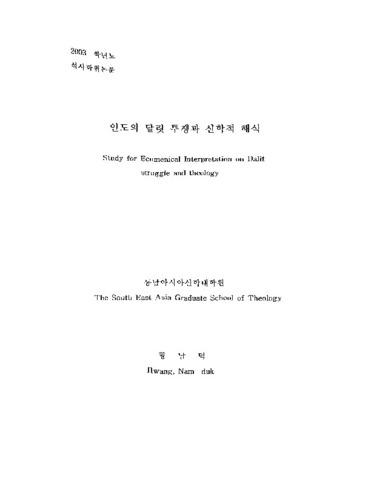
Study for ecumenical interpretation on Dalit struggle and theology
| dc.contributor.author | Hwang, Nam duk | |
| dc.date.accessioned | 2026-02-24T08:23:57Z | |
| dc.date.available | 2026-02-24T08:23:57Z | |
| dc.date.issued | 2003-01 | |
| dc.identifier.citation | Hwang, N. D. (2003). Study for ecumenical interpretation on Dalit struggle and theology [Unpublished master's thesis]. South East Asia Graduate School of Theology. | en_US |
| dc.identifier.uri | https://hdl.handle.net/20.500.12852/3744 | |
| dc.description | Abstract only | en_US |
| dc.description.abstract | Like the history of the christian world, the history of India stretches over a period of almost 2000 years. St. Thomas was the first of Jesus' disciples to arrive in India, and he evangelized the Gospel in Kelara State and built many churches there. The Christian church, first planted by St. Thomas, has grown strongly and continuously since the 1st Century A.D., and now includes strong institutions such as the United Church of India. Unfortunately, however, the existence of the Hindu caste system is still responsible for the oppression of many Indian people, especially those called Dalit, or untouchable people. Even though we are at the beginning of the 21st Century, and cultures, and societies all over the world are being changed by the pressures of globalization, and other external influences, the unique religious culture, and socio-economic system of India, has been able to resist the pressure to improve the human rights of Dalit people. The upper castes of Indian society have successfully resisted change to the socio-economic system, so that the Dalit’s human rights and dignity are just as badly oppressed as they were, in Jesus time. Now, the Dalits who have been the victims of oppression for 3,500 years, have started their struggle, to gain an identity as part of an equal, and just society. In this thesis, I aim to study the current position of Indian Dalit as part of a multi-religious society, as well as the treatment of Dalit throughout Indian history. I also aim to concentrate on the history of the Dalit struggle, before and after the British colonial period. I will also pay special attention to understanding the real desire of Dalits’ through presenting the leading strategy for struggle of Dr. Ambedkar, who is also known as the 'father' of the Dalit movement. The struggle that Dr. Ambedkar leads is against the caste system in India. Dr. Ambedkar believes that the caste system must by destroyed, in order to achieve the liberation of Dalit people from their oppressors. This means that the caste system in India is the fault of Hindu religious ideology, and that it is this ideology, and the social structure that it maintains, that is responsible for the oppression of Dalit people, and the main obstacle to their liberation. Since the 1980's Indian liberation theologians have been developing the contents of Dalit theology. The main themes of Dalit theology are based on the suffering and struggle of Dalit people in their daily life. I will discuss the biblical, and theological background of these themes, as well as the links between Dalit theology, and Asian liberation theology. Finally, I will suggest the need for a practical exchange program between Dalit churches in India and Minjung churches in Korea. I believe that this program should be carried out on the level of showing solidarity for Dalit liberation among Asian churches. The Minjung church in Korea must seek to develop a new style of mission, in conjunction with the Asian church, which will include the Dalit church in India, and build a Minjung-Dalit movement. This mission is the witness of Jesus Christ’s Gospel which inspires us to dream of a new heaven and a new earth. I believe that through this partnership we can overcome our many differences, to struggle against the upper caste, or ruling class, and to identify with the suffering Minjung of Asia. This should be our vision, in order to make a community of justice, reconciliation, and peace in Asia. | en_US |
| dc.format.extent | xi, 79 leaves | en_US |
| dc.language.iso | other | en_US |
| dc.publisher | The South East Asia Graduate School of Theology | en_US |
| dc.subject.lcc | BT 212 .H83 2003 | en_US |
| dc.subject.lcsh | Caste | en_US |
| dc.subject.lcsh | Castes and tribes of India | en_US |
| dc.subject.lcsh | Dalits | en_US |
| dc.subject.lcsh | Dalits--Religion | en_US |
| dc.subject.lcsh | Ecumenical liturgies | en_US |
| dc.subject.lcsh | Struggle--Religious aspects | en_US |
| dc.subject.lcsh | Theology | en_US |
| dc.subject.lcsh | Oppression | en_US |
| dc.title | Study for ecumenical interpretation on Dalit struggle and theology | en_US |
| dc.type | Thesis | en_US |
| dcterms.accessRights | Limited public access | en_US |
| dc.description.bibliographicalreferences | Includes bibliographical references | en_US |
| dc.contributor.department | South East Asia Graduate School of Theology | en_US |
| dc.description.degree | Master of Theology | en_US |
Файлы в этом документе
Данный элемент включен в следующие коллекции
-
Master of Theology [67]