
Показать сокращенную информацию
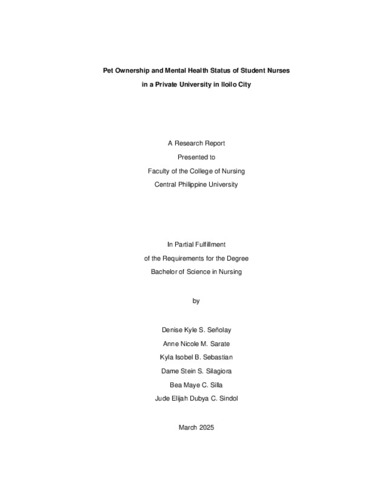
Pet ownership and mental health status of student nurses in a private university in Iloilo City
| dc.contributor.adviser | Partisala, Raymund | |
| dc.contributor.author | Señolay, Denise Kyle S. | |
| dc.contributor.author | Sarate, Anne Nicole M. | |
| dc.contributor.author | Sebastian, Kyle Isobel B. | |
| dc.contributor.author | Silagiora, Dame Stein S. | |
| dc.contributor.author | Silla, Bea Maye C. | |
| dc.contributor.author | Sindol, Jude Elijah Dubya C. | |
| dc.coverage.spatial | Iloilo | en_US |
| dc.date.accessioned | 2026-02-16T06:52:21Z | |
| dc.date.available | 2026-02-16T06:52:21Z | |
| dc.date.issued | 2025-03 | |
| dc.identifier.citation | Señolay, D. K. S., Sarate, A. N. M., Sebastian, K. I. B., Silagiora, D. S. S., Silla, B. M. C., & Sindol, J. E. D. C. (2025). Pet ownership and mental health status of student nurses in a private university in Iloilo City [Unpublished bachelor's thesis]. Central Philippine University. | en_US |
| dc.identifier.uri | https://hdl.handle.net/20.500.12852/3737 | |
| dc.description | Abstract only | en_US |
| dc.description.abstract | This study aimed to explore the relationship between the pet ownership and the mental health status of student nurses. Given the increasing demands of nursing education, which often lead to stress and mental health challenges, this research examined the role of pet ownership as a potential avenue for emotional support and psychological resilience. Further, a descriptive-correlational design was utilized, and data were gathered from 143 Level 3 student nurses selected through stratified random sampling. The study employed a validated researchers-made questionnaire to assess demographic profiles, pet ownership status, types of pets owned, and mental health status across emotional, social, psychological, and physical dimensions. The results showed that (80.4%) of respondents were pet owners, with dogs being the most common pet (69.8%), followed by cats and other animals. Among pet owners, (42.6%) scored 70 to 81 mental health status, and (35.7%) scored 82 or above mental health status, compared to non-pet owners, where a significant proportion exhibited lower mental health scores. In addition, statistical analysis confirmed a strong and significant relationship between pet ownership and mental health status (p = 0.003; Cramer’s V = 0.422) with the significance level set at α = 0.05. The findings underscored the value of pets in fostering emotional well-being, reducing stress, and promoting psychological stability among student nurses. | en_US |
| dc.format.extent | x, 93 leaves | en_US |
| dc.language.iso | en_US | en_US |
| dc.publisher | Central Philippine University | en_US |
| dc.subject.ddc | Filipiniana Theses 610.73072 Se61 | en_US |
| dc.subject.lcc | RT 71 .S46 2025 | en_US |
| dc.subject.lcsh | Nursing students | en_US |
| dc.subject.lcsh | College students--Mental health | en_US |
| dc.subject.lcsh | Nursing students--Psychology | en_US |
| dc.subject.lcsh | Human-animal relationships | en_US |
| dc.subject.lcsh | Pet owners--Psychology | en_US |
| dc.title | Pet ownership and mental health status of student nurses in a private university in Iloilo City | en_US |
| dc.type | Thesis | en_US |
| dcterms.accessRights | Limited public access | en_US |
| dc.description.bibliographicalreferences | Includes bibliographical references | en_US |
| dc.contributor.chair | Baldon, Charlie D. | |
| dc.contributor.committeemember | Gustilo, Alvin John H. | |
| dc.contributor.committeemember | Duller, Sarla F. | |
| dc.contributor.committeemember | Canaman, Tony Ray A. | |
| dc.contributor.department | College of Nursing | en_US |
| dc.description.degree | Bachelor of Science in Nursing | en_US |