

Ipakita ang simpleng tala ng item
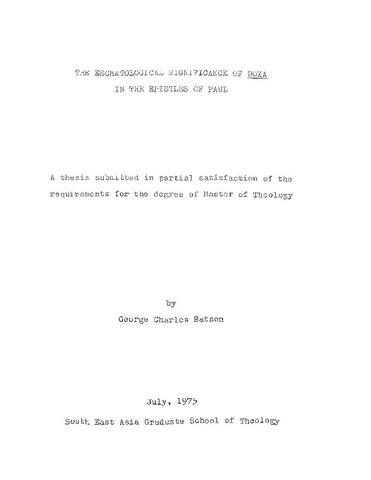
The eschatological significance of Doxa in the epistles of Paul
| dc.contributor.author | Batson, George Charles | |
| dc.date.accessioned | 2026-02-16T03:46:27Z | |
| dc.date.available | 2026-02-16T03:46:27Z | |
| dc.date.issued | 1975-07 | |
| dc.identifier.citation | Batson, G. C. (1975). The eschatological significance of Doxa in the epistles of Paul [Unpublished master's thesis]. South East Asia Graduate School of Theology. | en_US |
| dc.identifier.uri | https://hdl.handle.net/20.500.12852/3736 | |
| dc.description | Abstract only | en_US |
| dc.description.abstract | Doxa (English, "glory") occurs often in the Pauline corpus but seldom with the same content and is nowhere defined; consequently, a problem exists as to its meaning and significance. Doxa is usually thought of as a resplendent something generally associated with the visible manifestation of the Divine Being--the Shekinah of the Old Testament. On the other hand, the meaning of doxa as it pertains to the Christian is vague except, perhaps, as having some reference to the resurrection body; otherwise the Christian's understanding of doxa is rather nebulous and indefinable. To say that "glory" refers to the somatic radiance of the resurrection body, fails to convey the express thought of Paul. Further, it does not give the term doxa any content. This thesis submits Paul's doxa-texts to a thoroughgoing investigation, seeking to determine the eschatological significance of doxa in Pauline theology, its relation to the believer, and its significance for a Biblical perspective of the future. The method of investigation was as follows. First of all, the writer analyzed the occurrences of doxa in the Pauline corpus and determined which of these were used in an eschatological context. Having discovered 14- distinct occurrences, he proceeded to peruse these passages and found that doxa was frequently associated with Paul's doctrine of salvation, Rom. 8:30, the most striking of these passages, listed doxa last in the order of the divine acts involved in man's salvation. It was found that all of these acts--predestination, calling, justification, and glorification--were syntactically joined together so that there cannot be one of them without the others. Paul viewed all of these acts as linked together and essential in God's total redeeming action. This established a vital nexus between salvation and glorification in Paul. It constituted the investigator's point of departure as to the content and significance of doxa. The investigator then proceeded to formulate a trial hypothesis by showing that logical sequence was intended in the series of monergistic acts listed in Rom. 8:30. Applying the logical process of induction, he formulated the generalization (hypothesis) that if logical sequence is intended in Rom. 8:30, doxa being listed last is the conclusion of the salvation process. The context was decisive in revealing definite logical sequence in Rom. 8:30. At this point it became evident that any proper consideration of Paul's eschatological use of doxa must include his view of salvation. Turning to this area, the investigator found that salvation in the thought of Paul was seen to be in three tenses— past, present, and future. This was conveyed by the different salvation verb-forms that the apostle used, viz., "were saved" (esōthēmen), "are being saved” (sōzomenois), and "shall be saved” (sōthēsometha). Having considered the future tense of salvation in Paul, the investigator discovered it to be a major theme in the teaching of the apostle. Accordingly, most of his references speak of this future aspect of salvation. This is because salvation in its fullness is something that belongs to the believer's ultimate future. Next the investigator proceeded to test the trial hypothesis. If doxa is the conclusion of the salvation process, it must be shown not only to coincide with the future tense of salvation, but also its content must everywhere be identical with that of the future tense of salvation. In order to test the hypothesis, therefore, it became necessary to survey the Pauline literature and analyze the data that was involved in the future tense of salvation. Furthermore, the content of the future tense of salvation would give meaning and significance to doxa since this could only be gained descriptively from the content of future salvation. It was found that the content of the future tense of salvation was as follows: salvation from wrath at the last judgment (positively, ultimate juridical vindication), fullness of eternal life, full participation in the freedom of the sons of God, complete conformity to the image of Christ, and the "redemption" of the body. Comparing this content with that of doxa, the investigator found each one of these subsumed, in one place or another, under the term doxa. This, therefore, proved the validity of the hypothesis that doxa is the conclusion of the salvation process. As the conclusion of the salvation process, doxa characterizes the believer's consummate state of existence. The findings of this investigation may be stated as follows: 1 . Salvation in Paul is decidedly eschatological, finding its completion only in the end-time as inaugurated by the parousia. 2 . Doxa is the conclusion of the salvation process and characterizes the believer's consummate state of existence. 3. Glorification is a key-concept in Pauline soteriology, occupying pride of place as the grand conclusion of the salvation process. 4. The content of doxa consists of the believer's ultimate juridical vindication at the last judgment, fullness of eternal life, participation in the full freedom of sons of God, complete conformity to the image of Christ, and the possession of an immortal, spiritual body. 5. With the future orientation of doxa, it furnishes content for a proper Biblical perspective of the future. This study was intended to emphasize the Biblical perspective of a Christian's future. With the widespread influence of existential philosophy on theology (e.g ., Bultmann, as influenced by Heidegger), the believer's perspective of an ultimate future is dissolved into the existential futurity of each individual self in the moment of decision. Any moment or situation in which I have to make an ultimately significant decision may be called eschatological. Eternal life is the life I receive now; judgment is the crisis in which I stand now; the end-time is any present moment in which the issue of life and death is being decided. Thus existential significance replaces temporal reference in the definition of the believer's ultimate future. Moreover, it is this Biblical perspective that we hope live in the Third World. We live in a volatile decade in which socio-economic development tries men's souls, and the temptation is to make socio-economic development the principle of much of our action. The eventual outcome of being engrossed in this area is to place conversion in a socioeconomic framework of confrontation as in the case of Gutierrez's "theology of liberation." Gutierrez moves towards a synthesis of Christianity and socio-economic development. One of the basic principles of the "theology of liberation" is that only in the context of social revolution can. A policy of development be effectively implemented. This carries definite political overtones, and the only counterbalance, we submit, is for a Christian to maintain a transcendent perspective over development, a perspective of his ultimate future and fulfillment in his end-time glorification. | en_US |
| dc.format.extent | viii, 102 leaves | en_US |
| dc.language.iso | en | en_US |
| dc.publisher | South East Asia Graduate School of Theology | en_US |
| dc.subject.lcc | BT 212 .B38 1975 | en_US |
| dc.subject.lcsh | Bible. Epistles of Paul | en_US |
| dc.subject.lcsh | Doxa (The Greek word) | en_US |
| dc.subject.lcsh | Eschatology | en_US |
| dc.subject.lcsh | Glory of God | en_US |
| dc.subject.lcsh | Theology | en_US |
| dc.title | The eschatological significance of Doxa in the epistles of Paul | en_US |
| dc.type | Thesis | en_US |
| dcterms.accessRights | Limited public access | en_US |
| dc.description.bibliographicalreferences | Includes bibliographical references | en_US |
| dc.contributor.department | South East Asia Graduate School of Theology | en_US |
| dc.description.degree | Master of Theology | en_US |
Mga file sa item na ito
Lumilitaw ang item na ito sa mga sumusunod na (mga) Koleksyon
-
Master of Theology [66]