| dc.contributor.adviser | Duller, Sarla F. | |
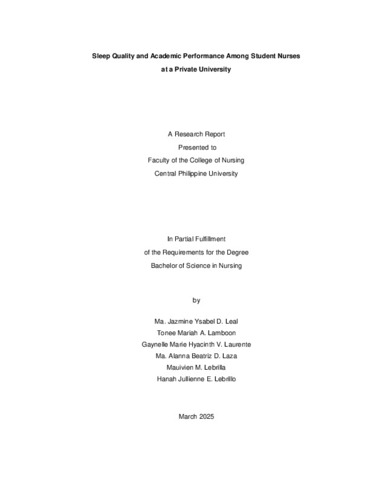
| dc.contributor.author | Leal, Ma. Jazmine Ysabel D. | |
| dc.contributor.author | Lamboon, Tonee Mariah A. | |
| dc.contributor.author | Laurente, Gaynelle Marie Hyacinth V. | |
| dc.contributor.author | Laza, Ma. Alanna Beatriz D. | |
| dc.contributor.author | Lebrilla, Mauivien M. | |
| dc.contributor.author | Lebrillo, Hanah Jullienne E. | |
| dc.date.accessioned | 2026-02-13T11:00:12Z | |
| dc.date.available | 2026-02-13T11:00:12Z | |
| dc.date.issued | 2025-03 | |
| dc.identifier.citation | Leal, M. J. Y. D., Lamboon, T. M. A., Laurente, G. M. H. V., Laza, M. A. B. D., Lebrilla, M. M., & Lebrillo, H. J. E. (2025). Sleep quality and academic performance among student nurses at a Private University [Unpublished bachelor's thesis]. Central Philippine University. | en_US |
| dc.identifier.uri | https://hdl.handle.net/20.500.12852/3729 | |
| dc.description | Abstract only | en_US |
| dc.description.abstract | This study aimed to determine the level of sleep quality and academic performance among student nurses at a private university in Iloilo City, Philippines, utilized the descriptive-correlational research design. Sleep quality was assessed through seven components, including subjective sleep experience, sleep latency, sleep duration, sleep efficiency, sleep disturbances, sleep medication, and daytime dysfunction. Academic performance was assessed based on the General Weighted Average computed from all level-specific subjects, including Related Learning Experience, during the first semester, academic year 2023–2024. The respondents were 286 student nurses who were randomly selected from the total population (N=1,004). This study utilized stratified random sampling using a spinning wheel. Data were gathered using the standardized Pittsburgh Sleep Quality Index questionnaire to assess sleep quality, while academic performance was measured using the General Weighted Average. Descriptive statistics (mean, frequency, percentage and tables) and inferential statistics (Spearman’s Rho) were used. The findings showed majority of students reported poor sleep quality, while a significant portion demonstrated good academic performance. The relationship between sleep quality and academic performance was analyzed using Spearman’s rho (+0.757), indicating a strong positive correlation between the two variables. Furthermore, there is a significant relationship between sleep quality and academic performance among student nurses (p=0.000), suggesting that students with good sleep quality were more likely to achieve excellent academic performance, while those with poorer sleep quality were more likely to experience lower academic performance. | en_US |
| dc.format.extent | x, 134 leaves | en_US |
| dc.language.iso | en_US | en_US |
| dc.publisher | Central Philippine University | en_US |
| dc.subject.ddc | Filipiniana Theses 610.73072 L473 | en_US |
| dc.subject.lcc | RT 71 .L43 2025 | en_US |
| dc.subject.lcsh | Nursing students | en_US |
| dc.subject.lcsh | Academic achievement | en_US |
| dc.subject.lcsh | Nursing students--Health and hygiene | en_US |
| dc.subject.lcsh | Sleep deprivation | en_US |
| dc.subject.lcsh | Private universities and colleges | en_US |
| dc.title | Sleep quality and academic performance among student nurses at a Private University | en_US |
| dc.type | Thesis | en_US |
| dcterms.accessRights | Limited public access | en_US |
| dc.description.bibliographicalreferences | Includes bibliographical references | en_US |
| dc.contributor.chair | Baldon, Charlie D. | |
| dc.contributor.committeemember | Polido, Betty T. | |
| dc.contributor.committeemember | Gustilo, Alvin John H. | |
| dc.contributor.committeemember | Canaman, Tony Ray A. | |
| dc.contributor.department | College of Nursing | en_US |
| dc.description.degree | Bachelor of Science in Nursing | en_US |