
Ipakita ang simpleng tala ng item
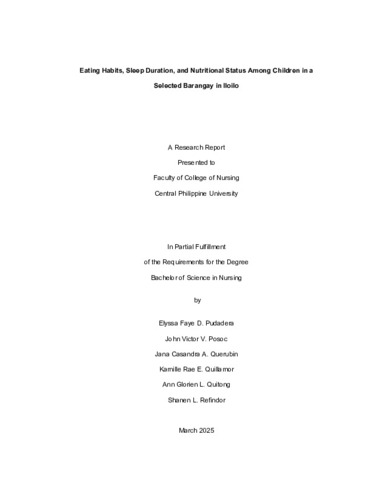
Eating habits, sleep duration, and nutritional status among children in a selected Barangay in Iloilo
| dc.contributor.adviser | Polido, Betty T. | |
| dc.contributor.author | Pudadera, Elyssa Faye D. | |
| dc.contributor.author | Posoc, John Victor V. | |
| dc.contributor.author | Querubin, Jana Casandra A. | |
| dc.contributor.author | Quillamor, Kamille Rae E. | |
| dc.contributor.author | Quitong, Ann Glorien L. | |
| dc.contributor.author | Refindor, Shanen L. | |
| dc.coverage.spatial | Iloilo | en_US |
| dc.date.accessioned | 2026-02-13T10:38:54Z | |
| dc.date.available | 2026-02-13T10:38:54Z | |
| dc.date.issued | 2025-03 | |
| dc.identifier.citation | Pudadera, E. F. D., Posoc, J. V. V., Querubin, J. C. A., Quillamor, K. R. E., Quitong, A. G. L., & Refindor, S. L. (2025). Eating habits, sleep duration, and nutritional status among children in a selected Barangay in Iloilo [Unpublished bachelor's thesis]. Central Philippine University. | en_US |
| dc.identifier.uri | https://hdl.handle.net/20.500.12852/3726 | |
| dc.description | Abstract only | en_US |
| dc.description.abstract | This study, which aimed to determine the eating habits, sleep duration, and nutritional status among children in a selected barangay in Iloilo, utilized the descriptive correlational research design. The respondents in the study were 209 children who were randomly selected from a total population of 437 children. The stratified random sampling was used to ensure fair and proportional representation across different age groups. The total consisted of children from seven different age groups. Researcher made validated questionnaires for reliability and accuracy were used in data gathering. The data was gathered face-to-face. Descriptive statistics were enlisted as frequency, mean, and percentage. Inferential statistics from the data were obtained using Spearman’s rho at a 0.05 level of significance. The results revealed that the children studied had poor eating habits, a sleep duration of less than nine hours, and were underweight based on their Body Mass Index (BMI). This implies a link between children's eating habits—characterized by poor food choices and eating practices—their sleep duration, which indicates insufficient rest, and their nutritional status, which falls under the underweight category. The findings indicate that the children's eating habits influenced their nutritional status, while their sleep duration also had a bearing on it. | en_US |
| dc.format.extent | x, 119 leaves | en_US |
| dc.language.iso | en_US | en_US |
| dc.publisher | Central Philippine University | en_US |
| dc.subject.ddc | Filipiniana Theses 610.73072 P962 | en_US |
| dc.subject.lcc | RT 71 .P83 2025 | en_US |
| dc.subject.lcsh | Children--Health and hygiene | en_US |
| dc.subject.lcsh | Food habits | en_US |
| dc.subject.lcsh | Health surveys | en_US |
| dc.subject.lcsh | Children--Sleep | en_US |
| dc.subject.lcsh | Nutrition--Evaluation | en_US |
| dc.title | Eating habits, sleep duration, and nutritional status among children in a selected Barangay in Iloilo | en_US |
| dc.type | Thesis | en_US |
| dcterms.accessRights | Limited public access | en_US |
| dc.description.bibliographicalreferences | Includes bibliographical reference | en_US |
| dc.contributor.chair | Baldon, Charlie D. | |
| dc.contributor.committeemember | Gustilo, Alvin John H. | |
| dc.contributor.committeemember | Cordero, Roque B. | |
| dc.contributor.committeemember | Canaman, Tony Ray A. | |
| dc.contributor.department | College of Nursing | en_US |
| dc.description.degree | Bachelor of Science in Nursing | en_US |