
Ipakita ang simpleng tala ng item
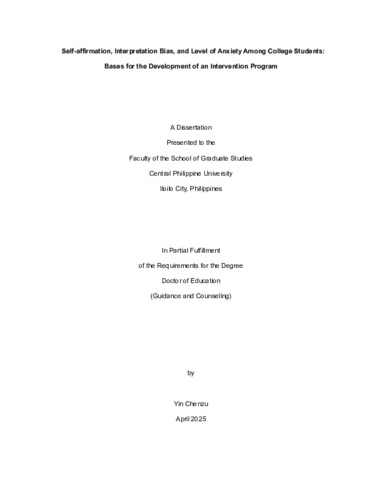
Self-affirmation, interpretation bias, and level of anxiety among college students: Bases for the development of an intervention program
| dc.contributor.adviser | Espina, Bibiana C. | |
| dc.contributor.author | Yin, Chenzu | |
| dc.coverage.spatial | Guangxi | en_US |
| dc.date.accessioned | 2026-02-12T11:07:10Z | |
| dc.date.available | 2026-02-12T11:07:10Z | |
| dc.date.issued | 2025-04 | |
| dc.identifier.citation | Yin, C. (2025). Self-affirmation, interpretation bias, and level of anxiety among college students: Bases for the development of an intervention program [Unpublished doctoral dissertation]. Central Philippine University. | en_US |
| dc.identifier.uri | https://hdl.handle.net/20.500.12852/3705 | |
| dc.description | Abstract only | en_US |
| dc.description.abstract | The purpose of this study was to determine the self-affirmation, interpretation bias, and level of anxiety among college students as the bases for the development of an intervention program. It further determined the relationship among self-affirmation, interpretation bias, and anxiety level of college students. The participants of the study were 368 college students at a university in Guangxi. The results showed that the participants' general anxiety, state anxiety, trait anxiety, and negative interpretation bias were at a low level. The level of self-affirmation and positive interpretation bias was high. Boys and girls had poor self- affirmation, positive interpretation bias, and girls scored significantly higher than boys. The general anxiety and trait anxiety levels of freshmen were significantly higher than those of sophomores and juniors. State anxiety and positive interpretation bias of liberal arts students were significantly higher than those of science students. The state anxiety level of rural college students was significantly higher than that of urban college students. The trait anxiety level and self-affirmation in the student cadre were significantly higher than those in the non-student cadre. The level of self-affirmation and positive interpretation bias was negatively correlated with general anxiety, state anxiety, and trait anxiety. Negative interpretation bias was positively correlated with general anxiety, state anxiety, and trait anxiety. It is suggested that the university should build a positive, confident, and harmonious campus to create full participation, full tracking, and all-around implementation of the mental health education atmosphere for college students. | en_US |
| dc.format.extent | iv, 242 leaves | en_US |
| dc.language.iso | en_US | en_US |
| dc.publisher | Central Philippine University | en_US |
| dc.subject.lcc | LB 2326.3 .Y56 2025 | en_US |
| dc.subject.lcsh | Anxiety | en_US |
| dc.subject.lcsh | Operant behavior | en_US |
| dc.subject.lcsh | Discrimination | en_US |
| dc.subject.lcsh | College students--Mental health | en_US |
| dc.subject.lcsh | College students--Psychological aspects | en_US |
| dc.subject.lcsh | Mental health education | en_US |
| dc.subject.lcsh | Interpersonal relations | en_US |
| dc.subject.lcsh | Social problems--Psychological aspects | en_US |
| dc.title | Self-affirmation, interpretation bias, and level of anxiety among college students: Bases for the development of an intervention program | en_US |
| dc.type | Dissertation | en_US |
| dcterms.accessRights | Limited public access | en_US |
| dc.description.bibliographicalreferences | Includes bibliographical references | en_US |
| dc.contributor.chair | Encio, Lucio T. | |
| dc.contributor.committeemember | Libo-on, Rowena M. | |
| dc.contributor.committeemember | Java, Margen A. | |
| dc.contributor.department | School of Graduate Studies | en_US |
| dc.description.degree | Doctor of Education major in Guidance and Counselling | en_US |
| local.subject | Self-affirmation | en_US |
| local.subject | Interpretation bias | en_US |