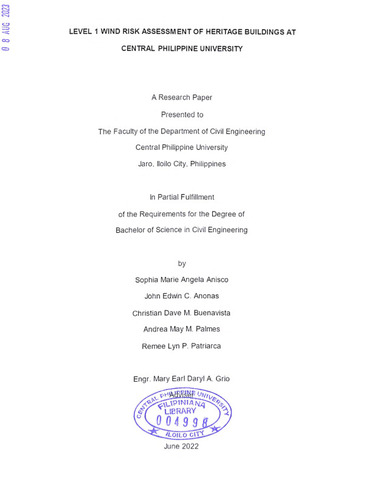

Level 1 wind risk assessment of heritage buildings at Central Philippine University
| dc.contributor.adviser | Grio, Mary Earl Daryl | |
| dc.contributor.author | Anisco, Sophia Marie Angela | |
| dc.contributor.author | Anonas, John Edwin C. | |
| dc.contributor.author | Buenavista, Christian Dave M. | |
| dc.contributor.author | Palmes, Andrea May M. | |
| dc.contributor.author | Patriarca, Ramee Lyn P. | |
| dc.date.accessioned | 2026-02-10T03:04:06Z | |
| dc.date.available | 2026-02-10T03:04:06Z | |
| dc.date.issued | 2022-06 | |
| dc.identifier.citation | Anisco, A. M. A., Anonas, J. E. C., Buenavista, C. D. M., & Patriarca, R.L.P. (2022). Level 1 wind risk assessment of heritage buildings at Central Philippine University [Unpublished bachelor's special paper]. Central Philippine University. | en_US |
| dc.identifier.uri | https://hdl.handle.net/20.500.12852/3688 | |
| dc.description | Abstract only | en_US |
| dc.description.abstract | The philosophy, Scientia et Fides, of the 117-year-old Central Philippine University Campus is reflected in the 25 cultural heritage (CH) buildings included in this research. The National Historical Commission of the Philippines (NHCP) has registered the said university as a Level 2 under the National Historical Landmark. Out of more than 100 buildings inside CPU's premises, 25 are considered CH buildings since they were built 50 years and above. The Rapid Visual Screening (RVS) form developed by the DLSU- Manila was adopted. Thus, a Level 1 Structural Wind Risk Assessment was conducted for the 25 CH buildings. Risk classifications were identified on each CH asset as low, medium, or high through the RVS instrument, including observing its hazard, risk, vulnerability, and other modifiers. The results revealed that out of the 25 CH buildings, 12 are at high risk, and 13 are determined to be medium risk. The process of how it was conducted was shown in the rest of the chapters of this study. A building information sheet was generated and included in this paper that provides a summary of the wind risk classifications for the CH buildings. Inscribing the year of construction on the building's facade and performing a regular rapid visual survey on the CH buildings are highly recommended for future studies to preserve its structural integrity and protect its occupants. Buildings with high wind risk indices are suggested to perform a Level 2 risk structural evaluation and must be monitored and modified with minimal alterations to preserve their cultural value | en_US |
| dc.format.extent | xi, 135 leaves | en_US |
| dc.language.iso | en_US | en_US |
| dc.publisher | Central Philippine University | en_US |
| dc.subject.lcc | TA 145. A55 2022 | en_US |
| dc.subject.lcsh | Historic buildings | en_US |
| dc.subject.lcsh | Risk assessment | en_US |
| dc.subject.lcsh | Historic preservation | en_US |
| dc.subject.lcsh | Emergency management | en_US |
| dc.subject.lcsh | Structural health monitoring | en_US |
| dc.subject.lcsh | Historic buildings | en_US |
| dc.subject.lcsh | Architecture--Conservation and restoration | en_US |
| dc.subject.lcsh | Cultural property--Protection | en_US |
| dc.subject.lcsh | Structural engineering | en_US |
| dc.title | Level 1 wind risk assessment of heritage buildings at Central Philippine University | en_US |
| dc.type | Special paper | en_US |
| dcterms.accessRights | Limited public access | en_US |
| dc.description.bibliographicalreferences | Includes bibliographical references | en_US |
| dc.contributor.committeemember | Dela Cruz, Shevanee Ruth | |
| dc.contributor.committeemember | Santacera, Linie Rose | |
| dc.contributor.committeemember | Beup, Lyndon-Erl | |
| dc.contributor.department | College of Engineering | en_US |
| dc.description.degree | Bachelor of Science in Civil Engineering | en_US |